"Religion is a culture of
faith; science is a culture of doubt."
Richard Feynman
The Electric Universe
Plasma Cosmology (PC) vis-à-vis the Electric Universe (EU)
The Electric Universe is a variant of
Plasma Cosmology, and it is necessary to
differentiate between the two. While they
share more similarities than differences,
it should be noted that EU ideas tend to
go a step further than the generally more
conservative approach of Plasma Cosmology.
While both viewpoints permit many ideas
previously excluded by Big Bang cosmology,
the Electric Universe looks at the bigger
picture and promotes more radical ideas
about the role of electricity in the
universe, from ancient mythology to catastrophism and the
mind-body connection.
Both PC and EU proponents acknowledge
that space is NOT electrically neutral, a
fact largely denied in conventional
astronomy.
"The cosmic theatre
has outgrown the Newtonian stage, and
we need a larger setting to understand
the broader cosmic drama. Instead of a
vision of isolated bodies turning
gear-like in a vacuum, we need a
vision of electrical circuits embedded
in a conducting medium whose
components drive each other and may be
in resonance. We have left the
familiar world of solids, liquids and
gasses. We have entered a world of
plasma, where the rules are different
and more complex. We now live in an
Electric Universe."
"It
is the Thunderbolt that steers the
universe." Heraclitus, ca. 500BC
A Brief History of The Electric Universe
The
term 'Electric Universe' has been used
before, but never in the same broad,
holistic sense. Australian Physicist,
Wal Thornhill, is regarded as the
founder of the synthesis and
interdisciplinary approach that is the
Electric Universe today. In July
2013 he was awarded the prestigious Sagnac
award for lifetime achievement at the 20th
annual conference of the Natural
Philosophy Alliance.
Previously, Charles
Bruce used the term in 1960 in: "An
All-Electric Universe". Electrical
Review, 162, pp. 1070-1075, 23 Dec.
1960.
Also, in 1901, in
another context, George Woodward Warder
said:
"There is no
loss of energy, as well as no loss
of atoms, in this vast Electric
Universe. The nebular hypothesis and
gravitation explain nothing."
As the Electric Universe
grows ever more popular we are likely to
see the terms bandied around more loosely.
Let's hope the true pioneers receive the
credit they deserve. See the Way
Forward.
Debunking the Debunkers
As interest in the Electric Universe continues to grow, so too does a parallel industry of self-styled “debunkers.” Too often, their critiques rely less on careful analysis than on dismissal and misrepresentation, with ad hominem attacks never far behind. One is left to wonder: what, exactly, is being defended?
In a recent YouTube video, one prominent critic described those exploring these ideas as a “gullible corner of the internet.” Such sweeping generalisations are easy to make, but far harder to justify. They say more about the tone of the discourse than about the audience itself.
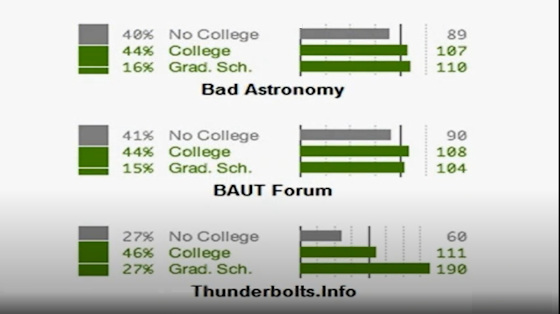
Independent analytics have, at times, told a rather different story. Data from Quantcast once indicated that visitors to Thunderbolts.info compared favourably with those of well-known mainstream sites such as Bad Astronomy (run by Phil Plait) and Universe Today. At points, Thunderbolts even ranked alongside — or above — outlets like Scientific American and Space.com.
This is not to suggest that audience metrics determine truth, nor that formal credentials are the sole measure of insight. It is simply to note that curiosity and critical thinking are not confined to any one camp — despite what caricatures might imply.
The Why Files (2023): A Case Study in Downstream Error
The problem does not end with individual debunkers. Once a narrative takes hold, it tends to propagate downstream with surprising ease — repeated, simplified, and often distorted along the way.
A recent example can be found in a 2023 episode of The Why Files, in which host AJ Gentile examined the Electric Universe.
At approximately 35:50, viewers are told that no evidence could be found for Wal Thornhill’s qualifications. In reality, Thornhill holds a B.Sc. in physics and electronics from the University of Melbourne (1964), and spent much of his career working in software engineering for IBM. His professional record — including publications and technical contributions — is publicly accessible through the IEEE (Institute of Electrical and Electronics Engineers). This is not obscure information, and it is readily verifiable.
More broadly, the episode repeats a familiar caricature: that proponents of plasma cosmology believe that “gravity is a lie.” This is not an accurate representation. Plasma cosmology does not deny gravity; it questions the assumption that gravity alone is sufficient to account for large-scale cosmic structure. Instead, it emphasises the role of electromagnetism and plasma dynamics — which govern the behaviour of the vast majority of visible matter in the universe.
Reducing complex ideas to slogans may be rhetorically convenient, but it comes at a cost. Once simplified in this way, those ideas are easily dismissed, and meaningful engagement becomes difficult. What begins as scepticism can quietly become something else: a form of gatekeeping, in which conclusions are defended rather than examined.
This pattern is not limited to content creators. A small but vocal subset of online audiences now mirrors this approach, particularly in comment sections. The tone is often dismissive, sometimes hostile, and rarely inquisitive. The result is predictable: discussion gives way to derision, and inquiry is replaced by tribal alignment.
Science, however, does not advance through slogans or certainty. It advances by confronting anomalies, testing assumptions, and allowing difficult questions to remain open.
An interesting and balanced
analysis from a mainstream source. All too
often the idea of gravity being of EM
origin is dismissed out of hand. Because
electromagnetism can be shielded and
gravity can't, it is generally assumed
that the two forces must be
irreconcilable. Such a view is clearly too
simplistic, however. This article is
therefore strongly recommended.
"However, astronomers have little to
celebrate in 2009. They have usurped the
role of the church and cast out a
modern-day Galileo!"
Wal Thornhill refers to Halton Arp as the
modern-day Gallileo in an attack on the
supposed year of astronomy, 2009.
"I always felt that science as the domain
of people from Oxbridge or Ivy League
universities and not for mere mortals was
a very bad idea." Benoit Mandelbrot
"Science is the belief in the ignorance
of the experts." Richard Feynman
Singing the Mind Electric — EM and Near-Death Experiences
What if the tunnel, the vortex, the magnet, and even the famous being of light aren’t poetic metaphors
or supernatural theatre—but signatures of electromagnetism? In this provocative thought experiment, researcher
Rens van der Sluijs explores whether the
out-of-body mind might behave like an electromagnetic phenomena interacting with Earth’s real space environment:
the ionosphere, auroral electrojets, Birkeland currents, and the polar portals of the magnetosphere.
The result is a rare attempt to bring near-death experience motifs back down to physics—not as reductionism,
but as a challenge to the stale natural vs. supernatural split. You don t have to accept every speculation to appreciate
the core provocation: if consciousness can decouple, what circuitry does it couple to?
“Distinctions between natural and supernatural do not help.” Rens van der Sluijs
The Book
The Electric Universe by
David Talbott and Wallace Thornhill can be
ordered here.
Electric Stars
Are stars powered from within, or does
the power come from elsewhere? This was
the question asked by Sir Arthur Eddington
in the 1920s. He settled for the former,
and this laid the foundation for current
mainstream models. Ralph Juergens asked
the question again in the 1970s, and opted
for the latter. According to Juergens,
stars shine because they are connected to
electric circuitry within galaxies. An
electric star's brightness thus depends on
the power of the electric current feeding
it, not on the amount of nuclear fuel
available to burn.
Stars thus behave as anodes in a galactic
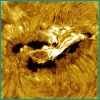
glow discharge. The many surface phenomena
that can be seen on the Sun — hot corona,
sunspots, prominences, flares, et al — can
all be explained by an electric Sun, but
are more difficult to understand from a
nuclear point of view. Nuclear reactions
take place on the surface, not in the
core, perhaps explaining why neutrino
numbers vary with sunspot cycles, and
these reactions are almost certainly
produced in the same way that we produce
them in the lab by accelerating particles
in an electric field.
Stars, galaxies, nebulae, and planets
are all affected by electric currents in
the plasma through which they move. If the
appearance of a star is determined largely
by its electrical environment, it follows
that it can change relatively quickly!
"The modern
astrophysical concept that ascribes
the sun's energy to thermonuclear
reactions deep in the solar interior
is contradicted by nearly every
observable aspect of the sun." Ralph E. Juergens
(1980)
"What we know is a drop,
what we don't know is an ocean." Isaac
Newton
This paper
from 2017 by Jamal S. Shrair of Budapest
University also explores the possibility
of an external power supply for our local
star. pdf link
"The external energy
supply to the sun is overwhelmingly
obvious even before space probes
(Voyagers and IBEX) have detected it.
The sunspot cycle, the surface
temperature, the reverse temperature
gradient and the existence of the
corona in itself, are some of the
outstanding evidence that point to the
external energy supply that
disagreements (or in direct
contradictions) with the concepts of
the Standard Solar Model (SSM)."
Walter Gekelman, quoted
below, is a professor of plasma physics at
the University of California, Los Angeles
(UCLA), and an elected fellow of the
American Physical Society. He has
developed and constructed numerous
meter-long devices to study fundamental
plasma processes under laboratory
conditions, the largest of which is the Large
Plasma Device.
"Magnetic flux ropes
are due to helical currents and form a
dense carpet of arches on the surface
of the sun. Occasionally, one tears
loose as a coronal mass ejection and
its rope structure is detected by
satellites close to the earth. Current
sheets can tear into filaments, and
these are nothing other than flux
ropes. Ropes are not static; they
exert mutual electromagnetic (JxB)
forces causing them to twist about
each other and merge." Walter Gekelman
NB. It should be noted that Plasma and
Electric Universe views are sometimes at variance in
respect of Stars. For example, while
plasma scientists recognise most of the
surface phenomena of our local star, the
Sun, as essentially electrical in nature,
the EU view goes a step further, arguing
that the Sun is electrically powered via
galactic Birkeland currents.
The EU approach may well begin to explain
the continuing surprises. From the
European Space Agency, ESA.int: Giant
flare from a tiny star!
"A star of about
eight percent the Sun's mass has been
caught emitting an enormous super
flare of X-rays a dramatic high-energy
eruption that poses a fundamental
problem for astronomers, who did not
think it possible on stars that small.
The culprit, known by its catalogue
number J0331-27, is an L dwarf. This
is a star with so little mass that it
is only just above the boundary of
actually being a star. If it had any
less mass, it would not possess the
internal conditions necessary to
generate its own energy."
Supernova 1987A
The plasma Z-pinch
morphology of supernova 1987A and the
implications for supernova remnants. From
the paper:
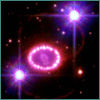
"Supernova
1987A is the closest supernova event
since the invention of the telescope. It
was first seen in February 1987 in the
nearby Magellanic cloud, a dwarf
companion galaxy of the Milky Way, and
only 169,000 light years from Earth. The
Hubble images of the rings of SN 1987A
are spectacular and unexpected.
Conventional theory did not predict the
presence of the three rings nor the
pattern of bright "beads" in the
equatorial ring of SN 1987A. The pattern
of brightening is not explained by an
expanding shock front into an earlier
stellar "wind". The axial shape of SN
1987A is that of a planetary nebula. It
seems that new concepts are required to
explain supernovae and planetary
nebulae. The new discipline of plasma
cosmology provides a precise analog in
the form of a Z-pinch plasma discharge.
The phenomena match so accurately that
the number of bright beads can be
accounted for and their behavior
predicted. If supernovae are a plasma
discharge phenomenon, the theoretical
conditions for forming neutron stars and
other "super-condensed" objects is not
fulfilled and plasma concepts must be
introduced to explain pulsar remnants of
supernovae."
The SAFIRE Project (2018 update)
Taking its lead from the Electric
Universe, this unique and independently
funded project is producing some startling
and remarkable results. According to the
web site https://safireproject.com/
The SAFIRE reactor
generates energy densities analogous to
the Sun's ... in a laboratory on Earth
A number of the Sun's
surface features, from anode tufting to
its temperature variations and stable
double layers, have been reproduced in the
laboratory. It has made major discoveries
that contemporary science cannot explain
at this time! The Safire Plasma
Engine is the only one of its
kind on the planet. The implications are
far reaching, and progress is regularly
reported at EU conferences.
The philosophy that
electricity plays a leading role in the
universe is the driving force. Two things
define Safire: this unique premise
combined with a powerful methodology.
Aureon Energy / SAFIRE Project (2026 update)
The Safire Project has already made
remarkable progress, including the
transmutation of elements! aureonenergy.com is
now the web site for this revolutionary project. From the web site:
"Aureon Energy’s mission is to develop and deploy advanced electromagnetic plasma technologies that transform long-lived heavy elements into safer materials while producing useful energy.
"Building upon years of experimental successes - The SAFIRE Project - Aureon applies rigorous scientific research and disciplined engineering to create practical reactor systems that work with nature’s fundamental processes rather than against them.
"Through the development of the Aureon Micro-Reactor (AMR), our objective is to provide the world with scalable solutions for clean energy generation and the remediation of legacy nuclear materials.
"We pursue this mission with a commitment to scientific integrity, safety, and the responsible stewardship of technologies capable of delivering lasting benefit to humanity."
Binary
Stars
There
is a problem with binary stars. To begin
with, why are there so many of them? In the
plasma lab, of course, currents tend to run
in braided pairs, but conventional astronomy
has a more tricky problem explaining this
doubleness.
Sirius, the nearest and brightest star,
has a partner, Sirius B, a tiny
white-dwarf. The trouble is, when we look
at Sirius B through Chandra, an X-ray
telescope, it appears much brighter. How
could this be?
Astronomers try to explain this in terms
of gravity, claiming that particles fall
into Sirius B so fast that the collisions
emit X-rays. But charged particles don't
care about gravity, so the real answer is
probably more simple. Nature abhors
inefficiency, so she uses electric
currents to produce X-rays, just as the
medical profession does.
The paradigm is shifting, slowly but
surely. Check out this paper.
From the paper: "We
propose a model for stellar binary
systems consisting of a magnetic and a
non-magnetic white-dwarf pair which is
powered principally by electrical
energy..."
(Alfvén’s seminal book,
Cosmical Electrodynamics, is credited.)
"There
are those who think that few discoveries
remain to be made. Others think that we have
only just begun." Anon
Sun
spot 'mysteries'
In
January 2005 our Sun produced a few more
surprises. On 20th Jan, in particular, it
produced a coronal mass ejection (CME) that
achieved velocities incomparably greater
than anything astronomers had seen before.
It normally takes more than 24 hours for the
charged particles of a solar outburst to
reach the Earth, but this CME achieved it in
just thirty minutes. Earth (some 96 million
miles from the Sun) was immersed in what
NASA scientists called 'the most intense
proton storm in decades'. Proton storms get
their name from the 'rain' of positively
charged particles that can hit the Earth.
"Any student of
physics who has heard of electric
charge and electric fields knows that
the easiest way to get electrically
charged particles to accelerate is to
apply an electric field to them." Don Scott
A NASA headline article concluded, "How
they were accelerated, however, remains
a mystery". From a plasma
perspective, of course, this phenomenon is
less mysterious. Retired professor of
electrical engineering, Donald Scott, was
not impressed and did not mince his words,
above.
Saturn's
Hot Poles
In
a recent press release, NASA scientists
admitted their surprise at finding a hot
north pole on Saturn. The northern latitudes
have been hidden from the sun since 1995,
and yet the temperatures are equivalent to
those at the south pole, which also
surprised initially. According to Glenn
Orton, one of the scientists monitoring the
infrared spectrometer onboard the Cassini
spacecraft:
"We had speculated
that the south pole hot spot was
connected to the southern, sunlit
conditions. Since the north pole has
been deprived of sunlight since the
arrival of winter in 1995, we didn't
expect to find a similar feature
there.
"The hot spots are
the result of air moving polewards and
being compressed as it descends over
the poles into the depths of Saturn.
The driving forces behind the motion,
and indeed the global motion of
Saturn's atmosphere, still need to be
understood."
In an Electric Universe, of course, there
is a simple explanation
Comets
Comets
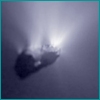
are little more than dirty snowballs according to conventional astronomy.
Recent observations, however, challenge this long-standing assumption.
In 2000, as Comet LINEAR (named after the telescope that discovered it)
approached perihelion, strange things began to happen. It brightened by
more than 50% in less than four hours, and expelled large
quantities of dust far more than could reasonably be explained by the
sublimation of ice and other volatiles. Then, to cap it all, the
Chandra X-ray Observatory discovered that this supposed
dirty snowball was emitting X-rays.
NASA attributed this unexpected emission to a poorly understood process
known as a charge-exchange reaction, which it claimed was first
proposed in 1997. In reality, however, the electric comet concept has been
around for more than a century, and it received coherent theoretical form
from Ralph Juergens in the early 1970s. Juergens proposed the
Electric Sun model, with the corollary that cometary comas and tails
are produced by an electrical exchange between the Sun and a comet.
The
Electric Comet
video from the Thunderbolts Project explores this perspective in detail.
Predictions
of the Electric Universe a remarkable track record.
Rock
and Roll
The ancients believed stones falling from
the sky originated from beyond our planet.
This was regarded as superstitious
nonsense by the scientific community up
until the 1800s, and martian meteorites
were not officially confirmed until the
late 20th century. The expression 'Modern
Science catches up with Ancient Knowledge' seems appropriate here.
Such stones are sometimes called
thunderstones as they have been associated
with thunder and lightning. This is of
particular interest to EU theorists, who
note that electrical phenomena frequently
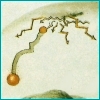
accompany stone or meteor falls. See the
witness diagram from 1751, right.
The light shows pose unanswered
questions. Many witnesses describe
electrical crackling and brightness
equivalent to a full moon! Comas are also
visible in the picture of the famous
Peekskill meteor, right, from October,
1992. One witness stated:
"When I saw it,
it was still in one piece. It was an
electric lime green with tendril-like
extensions. It did not look like it was
burning up so much as undergoing an
electrical interaction."
These features are consistent with
Electric Universe ideas. First we might
expect to see a glow discharge which, as
it approachs 'arc-mode' intensity, begins
to ablate material in addition to
velocity-driven air friction.
From the paper: "Anomalous
sounds from large meteor fireballs,
anomalous because they are audible
simultaneously with the sighting, have
been a matter for debate for over two
centuries..."
The Russian Meteor
Another
'Shock to the system', and no impact site on
earth! An EU perspective on this remarkably
well documented event.





 /
/