Black Holes |
|
|
| | | |
How It All Started: The Black Hole Placeholder
From Reification to Reality |
|
|
| | | |
|
Black holes began as mathematics before they became astronomy. Early solutions to Einstein's field equations implied a region from which light could not escape. For decades, this was treated as a formal consequence of the equations, not a directly observed object.
In physics, an infinity is often a warning sign. When a model predicts infinite density or infinite curvature, it may be revealing the limits of the model rather than unveiling the nature of reality.
Space-time curvature is a mathematical description of how gravity behaves — not necessarily a literal physical substance bending like rubber.
History offers a useful cautionary example. The Ptolemaic system of epicycles — circles upon circles used to explain planetary motion — could predict the positions of the planets with impressive accuracy. Yet the model ultimately failed because it described appearances rather than the underlying reality. Mathematical success alone does not guarantee physical truth. |
|
 |
| |
|
|
| Einstein’s Doubts |
|
|
| |
|
|
|
Although the Schwarzschild solution appeared to permit a region from which light could not escape, Einstein himself remained sceptical that such objects would exist in nature.
In a 1939 paper published in Physical Review, he argued that gravitational collapse would not produce the so-called Schwarzschild singularity. He wrote:
"The Schwarzschild singularities do not exist in physical reality."
Albert Einstein, 1939
Einstein regarded the singularity as a mathematical artefact a sign that the equations had been extended beyond their proper physical domain. For him, infinite density was not a prediction to celebrate, but a warning that the model might be incomplete.
At the time, this was not an isolated opinion. For many years, physicists treated black holes as formal consequences of the mathematics rather than confirmed objects in nature.
Only later particularly after the work of Oppenheimer, Penrose and Hawking did gravitational collapse into a black hole become widely accepted as a physical process.
For a detailed historical analysis of Einstein s 1939 paper, see:
J.D. Norton Einstein on Black Holes (University of Pittsburgh)
|
|
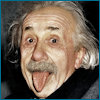
Albert Einstein (1879–1955)
|
| |
|
|
| From Speculation to Ontological Commitment |
|
|
| | | |
|
Over time, what began as a mathematical possibility came to be treated as a physical entity. X-ray binaries, quasars, galactic centres, and high-velocity stars were increasingly interpreted through the black-hole lens.
The transition was gradual a process of reification. What began as a plausible interpretation slowly hardened into the thing itself. The equations ceased merely to describe; they were taken to instantiate. The model became the object.
Reification is not deception; it is a habit of thought and a powerful one.
This does not mean compact objects are imaginary. It means the leap from compact and energetic to event horizon and singularity is often treated as settled long before such structures are directly observed.
|
|
"Science must begin with myths, and with the criticism of myths."
Karl Popper |
| | | |
| The Role of “Mathmagics” |
|
|
| | | |
|
Modern cosmology is often defended with a familiar move: if the mathematics is internally consistent and predicts key observations, then the underlying picture is treated as physical reality.
But mathematics is a language of description, not a guarantee of ontology. Prediction is not the same thing as explanation, and it is certainly not the same thing as mechanism.
When we speak of "space-time curvature" we are describing a powerful geometry. The danger is taking the geometry as the substance.
|
|
"There is no model of the theory of gravitation today, other than the mathematical form."
Richard Feynman
|
| | | |
| The Black Hole Wars: Hawking vs Susskind |
|
|
| |
|
|
|
One of the most revealing chapters in modern black-hole lore was not a telescope image but a theoretical dispute: the black hole information paradox.
In physics, information does not mean gossip or computer files. It refers to the complete physical description of a system the exact configuration of its particles, fields, and quantum states.
If information were truly destroyed, the laws of physics would, in a precise sense, forget the past. Quantum theory does not permit that.
For decades, Stephen Hawking argued that black holes destroy information. Leonard Susskind disagreed, insisting that information must somehow be preserved even if scrambled beyond practical recovery. The debate was public, intense, and foundational. It helped drive ideas such as black hole complementarity and the holographic principle.
In July 2004, at the GR17 conference in Dublin, Hawking conceded his bet with John Preskill regarding information loss. The episode is discussed in popular form in Susskind s book The Black Hole War.
"I now believe that information is not lost in black holes."
Stephen Hawking (July 2004)
The shift did not end debate. But it underscored something important: even at the highest levels of theoretical physics, the internal consistency of the black hole picture was still being actively negotiated.
|
|
"The boundary of a black hole, the event horizon, is not a physical surface."
Stephen Hawking |
| |
|
|
| From Geometry to Physical Reality |
|
|
| |
|
|
|
Black hole theory did not begin with observation. It emerged from the mathematical structure of general relativity. The field equations implied the possibility of gravitational collapse long before telescopes resolved compact galactic nuclei.
This is not a flaw. The predictive power of mathematics is one of the great achievements of modern physics. Yet the history of black holes also illustrates a subtle philosophical tension: geometry describes possible structures of space-time, while observation must determine which of those structures correspond to physical reality.
"The equations of general relativity tell us that there must be regions of space-time from which nothing can escape."
Roger Penrose
"The black holes of nature are the most perfect macroscopic objects there are in the universe: the only elements in their construction are our concepts of space and time."
Subrahmanyan Chandrasekhar
The black hole therefore begins as a geometric consequence. Observation tests those consequences but interpretation mediates between equation and image.
The distinction between mathematical necessity and empirical confirmation remains essential.
|
|
"The map is not the territory."
Alfred Korzybski
|
| |
|
|
| Event Horizons: Observed, or Inferred? |
|
|
| |
|
|
|
It is worth separating what is measured from what is inferred. We can measure radiation, spectra, polarization, variability, and the orbital motion of nearby matter. We can infer extreme compactness and strong gravity. But an event horizon is not a surface one can sample or directly detect; it is a global boundary defined by the causal structure of space-time a feature of the mathematical solution rather than a locally measurable object.
Even the Event Horizon Telescope images do not show an event horizon itself. They reveal a brightness depression a shadow-like region produced by gravitational lensing and plasma emission around a compact object. The horizon remains embedded within the theoretical framework used to interpret the data.
In 2014, Hawking proposed that gravitational collapse may produce apparent horizons temporary trapping surfaces but no true event horizons in the strict sense of regions from which nothing can escape to infinity.
"...gravitational collapse produces apparent horizons but no event horizons..."
Stephen Hawking (2014)
Hawking (2014): Information Preservation and Weather Forecasting for Black Holes
Nature (2014): "There are no black holes" (reporting Hawking's proposal)
Visser (2014): Physical observability of horizons
Regardless of where one stands on Hawking's proposal, the episode underscores a broader methodological point: the event horizon is often spoken of as if it were an observed entity. In practice, it is an interpretive boundary inferred within a particular theoretical model.
The distinction matters.
|
|
"The cosmical plasma physics approach is based on the laboratory study of plasmas."
Hannes Alfvén
|
| |
|
|
| M87*: Ring of Plasma, Shadow of Interpretation |
|
|
| |
|
|
|
The Event Horizon Telescope image of M87* was presented globally as the first photograph of a black hole. In practice, it is a computational reconstruction of a bright, ring-like emission region surrounding a darker centre, derived from sparse interferometric data.
The mainstream interpretation is that the ring traces hot plasma orbiting near the innermost stable circular orbit, while the dark region corresponds to a gravitational shadow shaped by extreme light-bending near an event horizon.
But consider what is directly present in the data: emission from plasma.
The image shows a luminous, structured plasma configuration. What it does not directly show is an event horizon itself. The horizon remains a theoretical boundary inferred from the gravitational model used to interpret the emission.
Critics have also highlighted the degree to which the image depends upon model selection and algorithmic reconstruction. Some have questioned discrepancies between the EHT reconstruction and independent radio observations of the M87 jet structure.
Similar reconstruction concerns have also been raised in relation to the EHT image of Sagittarius A*.
"Makoto Miyoshi, a researcher at the National Astronomical Observatory of Japan, and his colleagues suggest that the first image of Sagittarius A* may contain artefacts introduced during image reconstruction."
UniverseMagazine.com,
Image of the Sagittarius A* black hole proves to be erroneous
Such critiques do not eliminate the gravitational interpretation, but they do underline an important point: the published image is not a raw photograph but a model-dependent reconstruction.
The plasma is empirical. The horizon is inferred.
And that distinction matters when the public is told a boundary has been seen.
|
|

"What we observe is not nature itself, but nature exposed to our method of questioning."
Werner Heisenberg
|
| |
|
|
| Stephen Crothers: A Technical Critique |
|
|
| |
|
|
|
If Einstein’s hesitation reflected early caution, some contemporary critics argue that the difficulties lie not only in interpretation, but in the mathematical treatment itself.
Among the more technically detailed critics is Stephen J. Crothers, who has published a series of papers challenging standard physical interpretations of black holes and, in some writings, gravitational waves. His work focuses closely on the Schwarzschild solution, arguing that common presentations rely on coordinate transformations that may obscure the role of invariant quantities.
Crothers maintains that in general relativity, coordinate definitions and invariants are not peripheral issues but foundational ones. From this perspective, conclusions drawn from particular coordinate choices must be examined carefully to determine whether they reflect physical invariants or artefacts of representation.
His conclusions are not accepted within mainstream relativity research. Nonetheless, his arguments highlight an enduring methodological principle: when infinities appear, and when physical claims depend upon coordinate constructions, careful mathematical scrutiny is warranted.
Whether or not one agrees with his conclusions, the broader lesson remains: mathematical consistency, coordinate choice, and physical interpretation must be distinguished with precision.
Crothers The Black Hole Catastrophe (Reply PDF)
Discussion of Crothers views (TU Darmstadt)
Crothers paper on ViXra (abstract + PDF)
|
|
"The underlying assumptions of cosmologists today are developed with the most sophisticated mathematical methods and it is only the plasma itself which does not 'understand' how beautiful the theories are and absolutely refuses to obey them."
Hannes Alfvén
|
| |
|
|
| The Plasma Focus |
|
|
| | | |
|
Plasma cosmology asks a different first question: what does an electrically structured universe do naturally? It forms filaments, double layers, current sheets, and pinch instabilities. It accelerates particles. It produces jets.
In this view, many phenomena attributed to black holes may be explainable through current-driven plasma behaviour in and around galactic nuclei: intense discharge regions, rotating plasma structures, and electromagnetic energy transport over vast distances.
This does not require denying strong gravity. It challenges the reflex to invoke singularities whenever a system is energetic and compact.
|
|
|
| | | |
| The Plasma Gun: A Working Analogue |
|
|
| | | |
|
One of the practical strengths of plasma cosmology is that key behaviours can be reproduced in the laboratory. A simple plasma focus device — sometimes called a plasma gun — uses a bank of capacitors to drive a discharge between coaxial electrodes.
The discharge self-organises into a compact, filamentary structure (a plasmoid). When the configuration destabilises and collapses, energy is released and plasma can be expelled in tight, collimated beams along the axis.
The term plasmoid was coined by plasma physicist Winston H. Bostick, whose experiments explored plasma vortex behaviour and scaling analogues of astrophysical structure.

"Active galactic nuclei (AGNs) release vast amounts of energy, whose ultimate source is a supermassive black hole in the galactic nucleus. In so-called radio-loud AGNs, two relativistic jets of plasma emanate from the nucleus, presumably along the rotational axis of the black hole."
Denise C. Gabuzda, Matt Nagle, Naomi Roche
The Jets of AGN as Giant Co-axial Cables
The point is not that a tabletop device is a galaxy. It is that plasma naturally produces the kinds of structures we actually observe: filaments, pinches, plasmoids, and axial jets — with a demonstrable mechanism and an identifiable power source.
Plasma phenomena are observed to scale over many orders of magnitude. Filamentation, pinch effects, and collimated jets appear in laboratory discharges, in planetary magnetospheres, in solar eruptions, and in galactic structures. The morphology repeats even when the scale changes by factors of billions.
|
|
 |
Above. Looking down the barrel of a plasma focus gun. |
| |
 |
Above. NGC 6751 — a collimated, axial morphology on a vastly larger scale. |
|
| | | |
| Winston H. Bostick and the Plasmoid |
|
|
| | | |
|
Winston H. Bostick (1916 1991) was an American plasma physicist who coined the term plasmoid and conducted decades of experimental work on plasma focus and vortex phenomena. His laboratory studies demonstrated that plasmas can spontaneously organise into coherent, filamentary structures often forming force-free, minimum-energy configurations.
"...my experimental work in plasma physics for the last 36 years has shown that under many different circumstances plasmas containing nonrelativistic or relativistic electrons can spontaneously organize themselves into force-free, minimum-free-energy vortex filaments of a Beltrami morphology."
Winston H. Bostick
The reference to Beltrami morphology invokes the work of Eugenio Beltrami, whose equations describe helically twisted filament structures forms that appear in plasma discharges, Birkeland currents, and even biological systems such as DNA.
Bostick proposed that large-scale cosmic structures may reflect scalable plasma behaviour rather than purely gravitational collapse. The plasma phenomena he demonstrated in laboratory experiments are well established and remain part of standard plasma physics.
|
|

"The same mathematical expressions describe electrical phenomena at all scales."
Maxwell (summary of his field formulation)
|
| From Laboratory to Reality: The Plasma Answers |
|
|
| | | |
|
Jets are among the showpieces of black hole astronomy. Yet jets are also natural outcomes of plasma instabilities: current channels pinch, fields collimate flows, and energetic particles accelerate along filaments.
The key point is not that plasma explains everything. It is that plasma provides known physical mechanisms that can generate jet-like structures without requiring singularities or horizons as the first explanatory move.
Where the mainstream model begins with gravity and adds magnetism later, the plasma approach begins with electromagnetism in a conducting medium and asks what structures are expected.
Either way, observation must decide.
|
|
"Plasma processes are scalable over many orders of magnitude."
Anthony L. Peratt |
| | | |
| A Useful Discipline |
|
|
| | | |
|
Black holes may exist as physical objects. But when the public is shown a ring of plasma emission and told that an event horizon has been seen, we should pause.
A cautious approach is not denial. It is good science. Geometry proposes; observation disposes.
The universe is electrically structured. The Sun is electrically dynamic. And any cosmology that moves too quickly from equation to ontology risks mistaking description for reality. |
|
"As far as the laws of mathematics refer to reality, they are not certain; and as far as they are certain, they do not refer to reality."
Albert Einstein |


