|
|
|
|
"I would rather have
questions that can't be answered than
answers that can't be questioned." Richard
Feynman
|
|
|
| |
|
|
Ancient Testimony
Before proceeding, it is important to clarify the purpose of this discussion. The Electric Universe does not
depend upon the historical accuracy of ancient myths, nor does Plasma Cosmology stand or fall on their interpretation. Instead,
both provide a broader conceptual framework within which ancient traditions may be re-examined alongside evidence from
astronomy, plasma physics, archaeology, and comparative mythology. Whether any particular myth preserves genuine memories of
celestial events is a question to be considered on its own merits. |
|
|
| |
|
|
|
|
|
|
Mythology |
|
|
| |
|
|
|

The famous auroral
Dragon
photographed in 2019
|
|
"Are all these legends a
confused account of great events on a
planetary scale which were beheld in
terror simultaneously by men scattered
everywhere over the world?" Anonymous
Editor, Larousse Encyclopedia of Mythology
|
| |
|
|
"But when the
planets in evil mixture to disorder
wander,
What plagues and what portents, what
mutiny,
What raging of the sea, shaking of
earth,
Commotion in the winds!"
William
Shakespeare
Modern scholars typically define myth as a form of sacred history an attempt to explain the origins of the world and the foundations of cultural life. Yet if myth also preserves clues to the recent history of our solar system, as the evidence increasingly suggests, then its study becomes even more significant. Comparative mythology reveals striking cross-cultural parallels that imply a shared, planetary core to the world s oldest stories. This raises an intriguing question: How could planets that appear today as tiny, indifferent points of light have once commanded such overwhelming attention from our ancestors?
"All the
stories, characters, and adventures
narrated by mythology concentrate on
the active powers among the stars,
who are the planets."
Giorlgio de
Santilla, Hertha von Dechend, Hamlet's
Mill
According to the prevailing paradigm, the Nebular Hypothesis, planets and stars coalesced from a primordial dust cloud billions of years ago. In this model, it is assumed often without serious scrutiny that these bodies have occupied stable, unchanging orbits ever since. Anyone who questions this assumption is quickly reminded that the only forces permitted to shape planetary motion are gravity and inertia, and that any alternative would require mysterious or unknown influences. Yet when plasma and electromagnetism are taken into account, such influences are neither mysterious nor implausible.
A plasma-based view of the universe widens the interpretive frame considerably. It encourages us to revisit mythology without condescension, rather than dismissing ancient narratives as the products of ignorance or superstition. Perhaps our ancestors were not merely inventing stories, but attempting to describe a sky that behaved very differently from the one we observe today — one marked by dramatic instability, planetary encounters, and spectacular electrical phenomena. If so, the great myths of the world may preserve memories of events that would make our modern auroras and natural disasters seem modest by comparison.
"...A
'derivation' of the sword from a
'root' or archetype in lightning is
universal and world wide."
Ananada Coormaraswamy
Many mythological details seem impossible when viewed through the lens of the modern sky: flying and fire-breathing dragons, planets in unusual configurations, celestial battles, and countless other extraordinary motifs. It is tempting to dismiss such imagery as nothing more than creative invention. Yet this attitude encounters a serious obstacle these same impossible themes recur across cultures that had no contact with one another. Leading anthropologists, classicists, historians, and mythologists have long noted this striking continuity.
It is difficult to explain such global coherence as mere coincidence or imagination. Recognising the patterns — and the remarkable points of agreement across widely separated traditions — is therefore essential. Rather than treating these stories as isolated fantasies, we must consider the possibility that they preserve memories of a sky very different from the one we see today.
"...The extreme
preoccupation of most early
societies with celestial
imagery...appears to be part of a
world wide phenomenon."
Mark Bailey, astronomer, Armagh
Observatory
|
|
|
Saturn — The Central Luminary of the Sky
|
|
|
|
Saturn appears to
play perhaps the most important role in
ancient mythology, that of the central
luminary of the sky. This begs the
following questions:
Why did the early
astronomers celebrate the planet Saturn as
the first Supreme God? Why did the
ancients sacrifice their children to
Saturn? Why was the original Sabbath, the
most sacred day of the week, named after
Saturn? Why did ancient nations invoke
Saturn as the primeval Sun? Why did early
astronomers declare that Saturn ruled from
the celestial pole? Why do so many modern
religions carry remnants of Saturn
worship?
Dwardu Cardona's book
series, beginning with God Star,
is a comprehensive and fascinating look at
Saturn mythology.
"What
has Saturn, the far-out planet, to
do with the Pole? Such figures of
speech were an essential part of the
technical idiom of archaic
astrology."
Giorlgio de Santilla,
Hertha von Dechend, Hamlet's Mill
How do we begin to explain
the Saturnian ring symbolism that pervades
our cultures? For example:
The Halo of the
saints
The Royal Crowns
The ring on the finger given in
marriage
Circled crosses. Both the Celtic cross
and Egyptian ankh, for example
The Eye of Ra
The astronomically baffling star
inside the crescent
All of the above symbols have been identified as Saturnian in origin, and their echoes continue to resonate through the modern world. Many contemporary festivals preserve subtle traces of much older traditions. Christmas, for example, bears more than a passing resemblance to the Roman Saturnalia, celebrated in mid-December — a time of abundance and reversal, when ordinary restraints loosened and the world briefly seemed restored to an earlier Golden Age.
"When Saturn
ruled the skies alone
(That golden age, to gold unknown,)
This earthly globe to thee assign'd
Receiv'd the gifts of all mankind."
Johnathan Swift, A
Panegyric on the Dean
The black square is also
identified as a Saturnian symbol. See below.
The Kaaba at Mecca,
Islam's holiest site, is a large black
cube. Wherever they are in the world,
Muslims are expected to face the Kaaba
when performing the Islamic prayer, Salah.
In Judaism, Tefillin or
phylacteries are a set of
small black boxes which contain scrolls of
parchment inscribed with verses from the
Torah. In Rabbinic Judasim, the
predominant form of Judaism today,
tefillin are worn by adult Jews during
weekday morning prayers. In orthodox
communities they are worn only by men. In
academic circles, students will often
sport a square black head-dress during
graduation.
The isotopic ratios of water on Saturn and Earth are strikingly similar — an unexpected finding that raises profound questions about our planet’s early history. Could Earth once have been associated more closely with Saturn, perhaps even as a former satellite in a different celestial arrangement? Ancient memory seems to hint at such possibilities. The Atlantic Ocean, for example, was known in classical sources as the Sea of Kronos — a curious echo of Saturn’s ancient name.
"By
developing a new method for
measuring isotopic ratios of water
and carbon dioxide remotely,
scientists have found that the water
in Saturn's rings and satellites is
unexpectedly like water on the
Earth.
"The
results, found in the Icarus paper
'Isotopic Ratios of Saturn's Rings
and Satellites: Implications for the
Origin of Water and Phoebe' by
Planetary Science Institute Senior
Scientist Roger N. Clark, also mean
we need to change models of the
formation of the Solar System
because the new results are in
conflict with existing models."
Phys.org
Was Tolkien's famous book The
Lord of the Rings a reference to
Saturn?
"And some things that
should not have been forgotten were
lost. History became legend. Legend
became myth."
JRR Tolkien
|
|


|
|
The Saturn
Theory by comparative mythologist Ev
Cochrane of maverickscience.com. From the
paper:
"The Saturn theory,
in addition to presenting a
comprehensive model of ancient myth,
offers a radically different approach
to understanding the recent history of
the solar system. Briefly summarized,
the theory posits that the neighboring
planets only recently settled into
their current orbits, the Earth
formerly being involved in a unique
planetary configuration of sorts
together with Saturn, Venus, and Mars.
As the terrestrial skywatcher looked
upwards, he saw a spectacular and
awe-inspiring apparition dominating
the celestial landscape. At the heart
of heaven the massive gas giant Saturn
appeared fixed atop the North polar
axis, with Venus and Mars set within
its center like two concentric orbs
(see image, right, where Venus is the
green orb and Mars the innermost red
orb). The theory holds that the origin
of ancient myth and religion indeed
the origin of the primary institutions
of civilization itself is inextricably
linked to the numinous appearance and
evolutionary history of this unique
congregation of planets."
|
|
 |
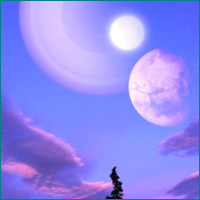
In Greek tradition, Kronos (Saturn) was remembered not merely as a god, but as the original ruler of heaven itself. Hesiod’s account of the Titanomachy preserves the memory of a cosmic upheaval in which the old celestial order was violently overthrown by Zeus and the Olympians.
|
|
An
artist's impression of the Polar
Configuration viewed in ancient skies,
left, with Saturn as the backdrop, Venus
middle, and Mars, front. |
| |
|
|
| Paradise Lost |
|
|
| |
|
|
|
Before the Electric
Universe merged with David Talbott's
recreation of mythic themes, Talbott noted
that today's world does not answer to the
ancient world. The video below from 1996,
Remembering the End of The World,
explores the Saturn model before plasma
and electromagnetism provided an
explanation for the celestial mechanics.
Remembering
The End of The World
The broader perspective offered post
merger in Symbols of an Alien Sky
includes an electrified cosmic environment
and high energy electrical events. Both
videos enjoy Talbott's captivating
narration.
Symbols of
an Alien Sky
In Remembering the End of The World
(at around 45 minutes), Talbott reflects
on the role of Saturn as the backdrop to
the cosmic drama. One part of his summary
goes something like this: A worldwide
tradition says that before a king ever
ruled on Earth, a prototype of kings arose
in heaven — the father of kings or
universal monarch. This was the model of
the good king. For example, the Hindu
Brahma, the Aztec Quetzacoatl, and the
Egyptian Ra. In the epic era known as the
golden age, this good king brought about
abundance. The Chinese called it the age
of Perfect Virtue, the Iranians called it
the age of the Brilliant Yima, The Danish,
Peace of Frodi, and so on. It was paradise
on Earth, or the Purple Dawn. The
Garden of Eden. It is impossible to
overstate the power of this memory among
different cultures. Saturn was the
founding king of the Golden Age, and most
cultures pay tribute to it with their
original Sabbath or Saturn day (Saturday).
Even today our language retains the age
old cultural ambivalence toward this most
ancient god. The word Saturnian expresses
the splendour and munificence of the
Golden Age, while the word Saturnine
(morose, gloomy) reflects the melancholy
of Paradise Lost.
Interestingly, following the death of Her Majesty Queen Elizabeth II on 8th September 2022, former UK Prime Minister Boris Johnson, speaking before the House of Commons, described her as “so unvarying in her pole-star radiance.”
YouTube link (from 1:17). |
|
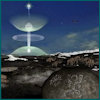
Another artist's impression of the Polar
Configuration, offset.
|
| |
|
|
| A Different Sun? |
|
|
| |
|
|
|
Ancient Babylonians were careful to
distinguish Shamash, their ancient Sun
god, from our current Sun, identifying it
with the distant planet Saturn. This led
Velikovsky to consider the possibility
that Saturn once loomed much larger in the
sky ... perhaps as a sunlike body over
satellite Earth!
The Popol Vuh, considered the 'Mayan
Bible', also attests to this:
"Like a man was
the sun when it showed itself It
showed itself when it was born and
remained fixed in the sky like a
mirror. Certainly it was not the
same sun which we see, it is said in
their old tales."
D Goetz & S. Morley, Popul Vuh
(Norman 1972)
Sol, Helios, and Kronos were actually
names for the first or old Sun. Many
cultures were careful to differentiate it
as the Best Sun, Superior Sun, or
Exemplary Sun, which ruled from the axis
of the sky around which the heavens
turned.
"Helios and Kronos
were one and the same God."
Franz Boll,
Classicist
As bizarre as the above may sound to the
uninitiated, the Saturn theory actually
suffers from an embarrassment of riches.
Early descriptions of the 'Sun' and
various planets from Mesopotamia and
elsewhere describe them as occupying
positions not possible within current
astronomical thinking.
For the Egyptians, Atum was was the
primeval sun, who ruled from the center
and summit of the sky.
"The great god lives,
fixed in the middle of the sky."
Egyptian Coffin
texts.
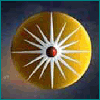
As part of the evolution of what is known
as the Polar Configuration, Venus assumed
a radiant appearance. Streams of luminous
plasma formed a flower like pattern across
the face of the ancient sun-god. Artists
impressions, above right and top right.
With the white background, the Mespotamian
Shamash from Wikipedia, is pictured right.
The 'cosmic wheel' and many other
identical symbols are common across
numerous ancient cultures. The cosmic
wheel is occasionally dismissed as a crude
representation of our current sun,
although this approach fails to account
for the bodies depicted in front of it,
among numerous other anomalies.
To the ancient Chinese, Saturn was not merely another wandering star. It was linked with the celestial Pivot — the still point of cosmic order, the “Spirit of the Pivot” around which heaven itself was imagined to turn. Saturn became associated with centrality, stability, repose, and cosmic governance.
Ancient Chinese tradition also linked Saturn with the Earth element, calling it the “Earth Star” (土星).
David Talbott went further still:
"Saturn was believed to have his seat at the pole."
David Talbott, The Saturn Myth
Elsewhere he writes:
"Chinese astronomers designated the celestial pole as ‘the Pivot,’ identifying the ‘Genie of the Pivot’ as the planet Saturn."
David Talbott, The Saturn Myth
Across widely separated cultures, echoes persist of a sacred cosmic centre — a celestial axis around which the heavens themselves revolved.
|
|


|
| |
|
|
| Venus |
|
|
| |
|
|
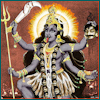
The planet Venus plays a prominent and often paradoxical role in ancient mythology. Converging images include the Babylonian torch and bearded star, the Mexican smoking star, the Peruvian long-haired star, and the Egyptian Great Star scattering its flame in fire. Across cultures, Venus is repeatedly depicted as a luminous serpent or dragon in the sky.
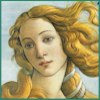
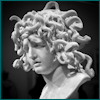
Venus is frequently portrayed as both radiant and destructive. In Greek mythology this duality appears clearly: the planet is associated not only with Aphrodite, the golden-haired goddess of beauty and desire, but also with Medusa, whose serpent-crowned visage embodies terror and ruin.
Venus has long been identified as both the Morning and Evening Star, and as Lucifer the Bringer of Light or Shining One, from the Latin lux ( light ) and ferre ( to bear or bring ). If Venus entered the inner solar system dynamically, or emerged from an earlier planetary configuration, this may help explain the widespread legends of a fallen or rebellious light-bearer.
Originally thought to be an Earth-like twin, Venus instead revealed itself as a world with an extraordinarily dense, hot atmosphere rich in hydrocarbons a prediction made in advance by Immanuel Velikovsky, and later confirmed. This was not the first controversy to fall in his favour.
"How you have fallen from heaven,
O morning star, son of the dawn!
You have been cast down to the earth,
you who once laid low the nations!"
Isaiah 14:12, Old Testament
"Quomodo cecidisti de caelo,
Lucifer, fili aurorae?
Deiectus es in terram,
qui deiciebas gentes."
From the latin Vulgate
Venus is also unique in rotating counter-clockwise relative to most other planets. In many ancient traditions, motion against the way was considered ominous. Such reversals recur symbolically in religious rites and mythic cycles, possibly preserving memory of an earlier period when Venus behaved in ways unfamiliar to the modern sky.
|
|
|
| Mars |
|
|
| |
|
|
The planet Mars is long associated with war, violence, and catastrophe. The month of March bears its name, and across cultures Mars appears as the scarred warrior, the thunderbolt-wielder, and the bringer of conflict.
Numerous traditions converge on strikingly similar imagery. The Blackfoot “Scarface,” also known as “Star Boy,” the Pawnee “Morning Star,” and the Greek Ares all share defining characteristics — wounds or scars, thunderous weapons, and violent celestial encounters. In Greek myth, when Ares is wounded, he roars with the din of a thousand warriors. In Hindu tradition, Indra bears a great scar upon his head, earned in cosmic battle while wielding the thunderbolt (vajra).
Ancient accounts also describe luminous connections forming between planets. Seneca wrote that “the space between two planets lights up and is set aflame,” a statement that resonates strongly with plasma-based interpretations of interplanetary electrical interaction.
Mars’ role as a visibly scarred world — both mythologically and geologically — reinforces the impression of a planet that underwent extreme stress in the recent past, remembered by human witnesses and preserved in mythic form.
"The space
between two planets lights up and is
set aflame by both planets and
produces a train of fire."
Seneca, Roman naturalist
Video link: Symbols of an Alien Sky Episode 2 - The Lightning-Scarred Planet Mars
|
|
|
| |
|
|
| When Venus and Mars Swap Masks |
|
|
| |
|
|
|
There is persistent confusion in mythological and popular traditions between the roles of Venus and Mars particularly in their identification as the Morning Star and associated light-bearers.
In common usage, the Morning Star is often identified exclusively with Venus, and by extension with Lucifer, the bringer of light. However, this simplification obscures a more complex celestial history preserved in myth.
The five-pointed star motif discussed throughout this section is better understood as a snapshot of a different sky — one in which Mars appeared positioned in front of Venus, accompanied by luminous plasma-stream structures. In such a configuration, Mars could temporarily assume the visual and symbolic role more commonly attributed to Venus.
Within the broader context of the polar configuration, this interpretation can be extended further to include Saturn as the central luminary, with Venus and Mars aligned along the polar axis. Under such conditions, visual dominance, colour, brightness, and apparent motion would differ radically from those observed today, naturally leading to later confusion in mythic attribution.
Conventional interpretations struggle largely because they assume the planets have occupied stable, long-term orbits throughout recorded history, and that the architecture of the solar system has remained unchanged in comparatively recent times. When this assumption is relaxed, many long-standing mythological contradictions begin to resolve.
|
|
|
| The Moon in myth |
|
|
| |
|
|
|
The moon
is mysterious. Relevant to this
particular page is the fact that the
further you go back in time the fewer
mentions of it there are to be found,
although numerous accounts speak of a sky
'before the moon arrived'. The Proselenes
of Arcadia, for example, claimed to have
been around before there was a 'moon in
the heavens' and, on the other side of the
earth, the ancient Tiwinaku culture of
Bolivia refer to a time when there was no
'moon in the sky', claiming it arrived
around 12,000 years ago. Zulu legends also
have it that our Moon was a spaceship
moved here by reptilian beings. See conspiracy theories
below for a mythological perspective on
dragon and serpent symbology.
"As far as science is
concerned, the Moon should not be
there! It's too large, too light, and
its density reveals no substantial
iron core. It's older than the Earth,
apparently, with no natural
explanation for the extra exposure
(baking) the lunar material has
received from the Sun. Lastly, and
perhaps most importantly, it rang like
a 'bell' for hours when NASA decided
to drop its launch rockets near
pre-placed seismic registers in order
to test the depth and make other
calculations about its crust."
ScienceDaily.com
If the moon arrived relatively recently,
is it such a stretch to contemplate other
planets in our solar sytem shifting on
their orbits?
|
|
|
| |
|
|
| The origins of Religion |
|
|
| |
|
|
|
Just a cursory glance at
modern religious festivals reveals many
underlying similarities that clearly have
their origin in astronomical events.
For example, Horus of Egypt
was born of the virgin Isis-Meri on
December 25th in a cave with the birth
being announced by a star in the East and
attended by three wise men. Mithra, Sungod
of Persia, was born of a virgin on
December 25th, and was considered a great
travelling teacher and master. Krishna was
born of the Virgin Devaki (The Divine
One), his father was a carpenter, his
birth attended by angels, wise men and
shepherds, and he was presented with gold,
frankincense and myrrh. Prometheus of
Greece descended from heaven as God
incarnate, to save mankind. Prometheus was
crucified, suffered, and rose from the
dead. The list goes on.
It should be noted that The
Sun 'dies' for three days on December
22nd, the winter solstice, when it stops
in its movement south, and is 'born again'
or 'resurrected' on December 25th, when it
resumes its movement north. In some areas,
the calendar originally began in the
constellation of Virgo, and the sun would
therefore be 'born of a Virgin'. The sun
is the 'Light of the World', and its
rising in the morning is the 'Saviour of
mankind'. The sun's 'followers' or
'disciples' appear to be the 12 months or
the 12 signs of the zodiac
(constellations), through which the sun
must pass.
It is difficult to ignore
the role of the heavens in mythology and
its adjunct, religious symbology.

|
|
|
| |
|
|
| Saturn's Dragon storm
- a living myth |
|
|
| |
|
|
|
Pictured right is a thunderstorm on
Saturn that has remained fixed since 2004,
much to the further puzzlement of the
scientific community. Meteorologists do
not fully understand terrestial lightning,
let alone the 'surprise' of lightning on
other planets, and Saturn produces
stupendous displays!
The spiraling shape of dragons and
serpents in mythology are strikingly
similar to plasma instabilities in the
laboratory and in space, a fact which
reminds us of the metamorphosing and
life-like qualities of plasma phenomena.
It should be little surprise, then, that
we see similar configurations of
electrified plasma in megalightning on
Saturn today.
|
|
 |
| |
|
|
| The Thunderbolts
of the Gods |
|
|
| |
|
|
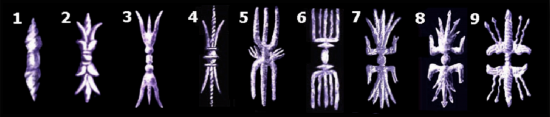
| Varying Greek
representations of the Thunderbolts of the
Gods. |
|
|
| |
|
|
 |
|
|
| |
|
|
| Electrical discharges
(plasma thunderbolts) in the laboratory,
stylized for clarity. Is any further
explanation required in view of the striking
visual similarities? Some mental gymnastics
are required in order to dismiss these as
merely coincidental. |
|
|
| |
|
|
 |
|
|
| |
|
|
| The mythic Assyrian warrior,
Ninurta, brandishing a thunderbolt, left,
and a Greek coin, right. |
|
|
| |
|
|
 |
|

Sprites in the upper atmosphere of Earth.
|
| |
|
|
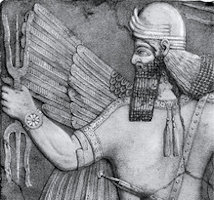
| In this close-up picture of
Ninurta wielding a thunderbolt, below, we
can also see the cosmic wheel mentioned
above, when Venus appeared as a radiant
flower in front of Saturn in the polar
configuration. It looks a bit like a wrist
watch, which some have interpreted as
evidence of advanced ancient technology.
However, this decorative symbol was
typically worn on both wrists, and very
often a headband, too. |
|
|
| |
|
|
 |
|
"...A
'derivation' of the sword from a 'root' or
archetype in lightning is universal and
world wide."
Ananada Coormaraswamy |
| |
|
|
| Odin's Thunderbolt in Norse
mythology. |
|
|
| |
|
|
 |
|
|
| |
|
|
|
Thunderbolt imagery is widespread the world over, yet few scholars pause to reflect on this ancient fascination. Most contemporary researchers assume the ancient sky was essentially identical to what we observe today. As today, so before — that is the default position. However, if the planets shifted on their
orbits within human memory, is it possible
that huge sparks jumped between them in
order to establish electrical equilibrium?
Were any such electrical interactions the
thunderbolts witnessed by the ancients,
and handed down via 'myth and legend'?
Again, this notion is anathema to the
gradualist paradigm. Here is a
conventional academic take:
"It should be
admitted that all of these
thunderweapons Indian, Hittite, and
Greek are variations of the same
basic form, a form that really looks
nothing like the thunderbolt."
R. Miller, Iconographic
Links between Indic and West Asian
Storm Gods, 2016
It is interesting that while
Miller notes the visual similarities of
thunderbolts across different cultures, and
grasps their association with lightning
(thunderstorms), he is unaware that these
thunderbolt morphologies are more or less
identical to those that have been recreated
in the laboratory. Typically, the earliest
artistic representations of a thunderbolt
are bidirectional three-pronged tridents, as
per those pictured above.
|
|
|
| |
|
|
| The Days of the Week |
|
|
| |
|
|
| It is easy to forget that
the days of the week are named after the
planets in many languages, and especially
the older languages of Latin derivation.
Some are obvious, such as Monday, short for
Moon day, Sunday, short for Sun Day, of
course, and Saturday, short for Saturn day
the original Sabbath day. Consider the
following. |
|
|
| |
|
|
| Planets |
| Moon |
Mars |
Mercury |
Jupiter |
Venus |
Saturn |
Sun |
| Days |
| Monday |
Tuesday |
Wednesday |
Thursday |
Friday |
Saturday |
Sunday |
| French |
| Lundi |
Mardi |
Mercredi |
Jeudi |
Vendredi |
Samedi |
Dimanche |
| Spanish |
| Lunes |
Martes |
Miércoles |
Jueves |
Viernes |
Sábado |
Domingo |
| Latin |
| Lūnae |
Mārtis |
Mercuriī |
Iovis/Jovis |
Veneris |
Saturnī |
Sōlis |
| Greek Gods |
| Selene |
Ares |
Hermes |
Zeus |
Aphrodite |
Kronos |
Helios |
| Viking Gods |
| Mani |
Tyr/Tiw |
Odin/Woden |
Thor |
Frigg/Freyja |
* |
Sol |
| Swedish |
| Måndag |
Tisdag |
Onsdag |
Torsdag |
Fredag |
Lördag |
Söndag |
| Anglo-Saxon |
| Monandæg |
Tiwes- |
Wodnes- |
Þunres- |
Frige- |
Sæternes- |
Sunnan- |
|
|
"I
conceive of nothing, in religion, science or
philosophy, that is more than the proper
thing to wear, for a while."
Charles Fort |
| |
|
|
Hindu astrology also uses the concept of days
under the regency of a planet. The
Wikipedia page goes into some detail on the many associations in different languages and cultures. It begins by saying something like:
the names are derived from classical planets in Hellenistic astrology, which
were in turn named after contemporary
deities, a system introduced by the Roman
Empire during Late Antiquity.
Planetary Gods?
Is it not possible that the names of the
gods were derived from the planets, and
not the planets from the gods? Were the
planets the gods, in other words, if they
occupied different orbits much closer to
the earth in past ages? This euhemeristic
approach would begin to explain the
commonalities across languages and
cultures. There is no doubting that the
ancients had a fascination with the
heavens. Furthermore, there are so many
key points of agreement when it comes to
the personalities ascribed to the planets
of our solar system, as described above.
Again, can over-wrought imagination alone
account for these remarkable concordances?
Please note that it is not the purpose of
this web site to promote nor denigrate any
views in respect of an intelligence behind
the universe. That's a separate
philosophical debate, and one beyond the
scope of this subject matter which falls
under the broad heading of comparative
mythology.
"The peoples of
ancient Mesoamerica keenly observed
the sky and used the calendar to
predict solar and lunar eclipses, the
cylce of the planet venus, the
apparent movements of the
constellations and other celestial
events. To them, these occurences were
not the mechanical movements of innate
celestial bodies but constituted the
activities of gods, the actual
recapitulation of mythical events from
the time of creation."
Kaule Taube, Aztec
and Maya myths, P14.
"With one voice,
every culture declared that great gods
once ruled the world, before they
departed for remote regions. Let the
world's first astronomers point the
way for us. They knew that what the
myths called Gods were planets, and
aspects of planets. Planets appeared
close to the earth in heaven spanning
configuration. Memories of that
celestial splendour still surround us,
even if humanity later forgot much
more than it remembered."
David Talbott,
comparative mythologist
|
|

Another view of Venus
within the Polar Configuration, above.
|
| An early philosophical view |
|
|
| |
|
|
|
The early Greek philosophers can be seen as providing a bridge between the
old world of myth and the emerging world of rational enquiry. Plato and
his student Aristotle both acknowledged that the gods were originally
associated with astronomical bodies, while also suggesting that ancient
myths preserved memories of real natural events.
Plato (427–347 BC) taught that the myth of Phaethon describes real
events in nature:
"[It] really signifies a declination of the bodies moving in the
heavens around the earth, and a great conflagration of things upon
the earth."
Aristotle (384–322 BC) likewise wrote:
"A tradition has been handed down by the ancient thinkers of very
early times ... to the effect that these heavenly bodies are Gods ...
the rest of the tradition has been added later in a mythological form
to influence the vulgar..."
|
|
"It is one thing to show a man that he is in error, and another to put him
in possession of truth."
John Locke
|
| Conspiracy
theories |
|
|
| |
|
|
|
Conspiracy theories abound in respect of
many of the archetypal symbols mentioned
above, and it is often claimed that
certain groups secretly worship Saturn
(which they associate with 'Satanism'), or
Venus (Lucifer or the Morning Star in
western tradition). As we have seen above,
these symbols pervade modern religions and much more. Caution is obviously recommended as
many of the symbols under discussion are
ingrained in our culture and subconscious,
and are often misunderstood. At best, when
touched upon they are generally considered
an artifact of the human mind.
"The ultimate
origin of neary all folktales and
myths must remain a mystery."
Stith Thompson
Saturn is associated with the number six.
It's the sixth planet from the Sun, and it
is also associated with the black cube,
mentioned above. A cube has six sides, of
course. The hexagon pattern seen on
Saturn, below left, surprised many. Again,
caution is urged before jumping to
negative conclusions. Consider that humans
are made from carbon, for example, and
that carbon atoms comprise six irons, six
electrons, and six neutrons. Six doesn't
have to be an evil number, but anything
can be inverted.
(Numerology is an interesting but
speculative subject matter. For example:
3x6=18. 1+8=9. Nine is considered a
universal number. Nikola Tesla, of course,
was obsessed with the numbers 3, 6, and 9,
which also add up to 18, and then 9. And
so on. He is supposed to have said that 3,
6, and 9 were the key to the universe.)

The warrior or hero figure slaying or banishing the dragon or serpent is an archetypal symbol. England has St George and the Dragon — a tradition it shares with Georgia and Catalonia in Spain, among others — while Ireland has St Patrick, who is said to have rid the country of snakes. In Norse and Scandinavian mythology, Fáfnir (the mythical dragon) was slain by Sigurd. The theme is widespread. See also Ninurta chasing Anzû with his thunderbolts, pictured above. David Icke has taken a sustained interest in reptilian symbolism, extending this to the claim that the world is covertly ruled by reptilian hybrids. It seems more plausible, however, that the enduring appeal of this idea lies not in the literal truth of the claim, but in the power of the underlying archetype. Reptilian imagery has deep mythological and psychological roots, long predating any modern conspiracy narrative.
It is worth noting, in passing, that in the context of the Purple Dawn discussed above, both plants and reptiles are known to thrive under red or purple light. Some readers may be tempted to draw symbolic connections here, though no such interpretation is required.
The word conspiracy is frequently used without regard for important distinctions between symbolism, speculation, and evidence. As a result, unconventional ideas are often categorised and dismissed before they are examined.
Wikipedia functions reasonably well for settled knowledge, but is a
poor guide to unresolved or controversial subjects. In these cases, editorial framing often substitutes for
analysis, and alternative paradigms such as the Electric Universe are routinely dismissed rather than critically assessed.
See here for the ancient alien hypothesis.
|
|

"Heavenly fire is spit forth from by the
planet as crackling charcoal flies from a
burning log." Pliny, Roman naturlist
|
| |
|
|
| Graham Hancock |
|
|
| |
|
|
|
Graham Hancock has popularised the idea of a lost or fallen civilisation
in prehistory, arguing that the pyramids and a range of other ancient structures point to cultures more advanced than those
acknowledged by conventional archaeology. More recently, he has proposed that a global cataclysm — most likely a comet impact,
in his view — struck Earth around 12,000 years ago, roughly coinciding with the Younger Dryas, and that this event precipitated
the collapse of that earlier civilisation. In this respect, Hancock s narrative echoes much older Atlantean traditions. The discovery
of Göbekli Tepe in modern-day Turkey, dated to around 9,000 BCE, has undeniably unsettled established archaeological
timelines. At the very least, it invites renewed questioning of orthodox assumptions about the development of complex human
societies a point Hancock has been quick to emphasise.
David Talbott, by contrast, does not frame the past primarily in terms of a
lost technological civilisation. Instead, he argues that dramatic changes in planetary configurations led to Earth-shattering
events remembered in myth and legend, catalysing a profound shift in human perception and consciousness. From this perspective
emerged the myth-making epoch, during which monumental structures arose not as remnants of a vanished civilisation, but as
symbolic acts of remembrance. In Talbott s view, the Golden Age is therefore best understood as a mythic and experiential
memory rather than a conventional historical society.
Perhaps these differing views are not mutually exclusive, and there is clearly some overlap. Hancock has
worked with geologist Robert Schoch, for example, who has spoken at an Electric Universe conference and
has noted the plasma-related characteristics
of much ancient rock art. As things stand, however, neither Talbott's nor Hancock's interpretations are
regarded as acceptable within mainstream science or archaeology — a judgement reflected in their treatment on Wikipedia,
a resource that should be approached with caution on contested subjects.
|
|
 |
| |
|
|
|
Conclusion
|
|
|
|
Many mysteries remain from the myth-making epoch, yet they begin to cohere once we
allow for the possibility that planetary configurations within human memory were once very different from those we observe
today. In the earliest traditions, time and planets are not described as abstract concepts; the gods were the planets,
presiding over a remembered age of order and abundance the Golden Age, later mythologised as the Garden of Eden.
When this age ended, its survivors appear to have developed an intense preoccupation with the heavens. The planets were
tracked with extraordinary care, their motions recorded and ritualised, as though to guard against the return of catastrophe.
Monumental temples and sacred architectures arose from this impulse. Much has been forgotten, but the underlying symbols and
themes persist with remarkable consistency across cultures. Modern apocalyptic anxieties may reflect the same deep-seated
memory sometimes expressed not only as fear of recurrence, but as an equally powerful reluctance to confront what may once
have occurred.
"Contents of an
archetypal character are
manifestations of processes in the
collective unconscious. In the last
analysis, therefore, it is
impossible to say what they refer
to."
Carl Jung
While psychologists readily acknowledge the role of archetypes, there has been comparatively little interest in exploring
their origins. Their significance is recognised, yet the question of how such patterns arose is often set aside, as if beyond
recovery. Against this background, the work of David Talbott, Dwardu Cardona, and Ev Cochrane on recurring mythic themes may
offer a path toward understanding the historical and experiential roots of archetypal symbols. Whether psychologists,
anthropologists, or others will be willing to engage with this possibility — particularly within conservative academic
settings — remains an open question.
Jordan Peterson's interpretation of the dragon provides a particularly interesting example. His psychological analysis asks
what the dragon means to the human mind; but another question comes first: where did the dragon come from? This
question is explored further in Dragons, Dissonance, and the Mind.
|
|
|
| |
|
|
| Intellectual inertia |
|
|
| |
|
|
|
The historian of science and author Arthur Koestler offered a memorable observation on why genuinely new
ideas so often encounter resistance within established institutions:
"The inertia of the human mind and
its resistance to innovation are most
clearly demonstrated not, as one might
expect, by the ignorant mass which is
easily swayed once its imagination is
caught but by professionals with a
vested interest in tradition and in
the monopoly of learning.
Innovation is a twofold threat to
academic mediocrities: it endangers
their oracular authority, and it
evokes the deeper fear that their
whole, laboriously constructed
intellectual edifice might
collapse. The academic
backwoodsmen have been the curse of
genius from Aristarchus to Darwin and
Freud; they stretch, a solid and
hostile phalanx of pedantic
mediocrities, across the
centuries."
Arthur Koestler, The Sleepwalkers [New York, 1959], p. 427.
|
|
|
|
|
| |
|
|
|
|