"We are trying to prove ourselves wrong as quickly as possible, because only in that way can we find progress." Richard Feynman
Cutting Edge
The purpose of this discussion is not to suggest that any single observation overturns conventional
cosmology. Rather, it is to examine whether a number of apparently unrelated observations become more coherent when viewed
within a broader conceptual framework in which plasma and electromagnetism play a central role. Each should be considered
on its own merits.
Gravity remains one of the great unsolved problems in physics. You
could be forgiven for thinking it is a well-understood phenomenon,
but in truth we still do not understand its underlying mechanism.
We can describe gravity mathematically with remarkable precision,
yet describing its behaviour is not the same as explaining what it
actually is. See Newton's famous quotation, right.
Einstein sought to extend Newton's description by introducing
spacetime as a four-dimensional geometry in which mass tells
spacetime how to curve, and curved spacetime tells matter how to
move. General Relativity has enjoyed extraordinary success in
predicting many gravitational phenomena. Nevertheless, it remains a
mathematical description rather than a physical mechanism. Does the
concept of curved spacetime explain gravity, or does it simply
describe its effects in a different mathematical language?
"You can imagine that I look back on my life's
work with calm satisfaction. But from nearby it looks quite
different. There is not a single concept of which I am convinced
that it will stand firm, and I feel uncertain whether I am in
general on the right track." Albert Einstein
Gravity is also commonly described as a property of mass. Yet mass
itself remains something of a mystery. Although the discovery of
the Higgs boson completed the Standard Model as presently
formulated, it did not explain the deeper nature of mass or why
matter possesses inertia in the first place. Likewise, hypothetical
gravitons remain undetected, and gravity has yet to be reconciled
with quantum theory.
In General Relativity, gravity emerges from the curvature of
spacetime itself. Whether this curvature represents a physical
entity or a mathematical abstraction remains an open philosophical
and scientific question.
"There is no model of the theory of gravitation
today, other than the mathematical form." Richard Feynman
The difficulty extends beyond the Solar System. Observations of the
Milky Way and other galaxies suggest there is insufficient visible
matter to account for their measured rotation curves. The prevailing
solution is to propose the existence of dark matter, an invisible
component believed to outweigh ordinary matter by roughly five to
one. Despite decades of searching, however, its nature remains
unknown.
These unresolved questions have encouraged some researchers to
explore alternative approaches in which gravity, inertia and mass
may emerge from deeper electromagnetic or plasma processes. Whether
such ideas ultimately prove correct remains to be seen, but they
serve as a reminder that gravity is still one of the least
understood of nature's fundamental phenomena.
"But hitherto I have not been able to discover the cause of those
properties of gravity from phenomena, and I frame no hypotheses."
Isaac Newton
The Higgs Boson: Discovery, or Beginning? Your disCERNment Is Recommended.
More than ten billion dollars have been invested in the Large Hadron Collider (LHC) at CERN (Conseil Européen pour la Recherche Nucléaire) near Geneva. Its principal objective was to search for the long-predicted Higgs boson — the particle popularly nicknamed the "God particle" — while exploring physics beyond the Standard Model.
The announcement in July 2012 was rightly celebrated as a remarkable experimental achievement. In science, however, major breakthroughs rarely mark the end of a story. More often, they open the door to new questions. Did the Higgs boson finally explain the origin of mass, or did its discovery simply reveal how much remains unknown?
Peter Higgs proposed a new field and its associated boson to explain how certain elementary particles acquire mass within the Standard Model. Unlike the charged particles that make up ordinary matter, however, the Higgs boson carries no electric charge. That immediately raises interesting questions. How can a massive particle exist without charge? What is its structure? Is it truly elementary, or might it itself be composed of something more fundamental?
Throughout the history of science, elegant mathematics has sometimes pointed towards profound physical truths. At other times it has described nature successfully without revealing the underlying mechanism. Ptolemy's epicycles produced respectable predictions for centuries, yet ultimately proved to be a mathematical description rather than a physical explanation. The question is not whether mathematics is useful — it unquestionably is — but whether every mathematically successful concept necessarily corresponds to physical reality.
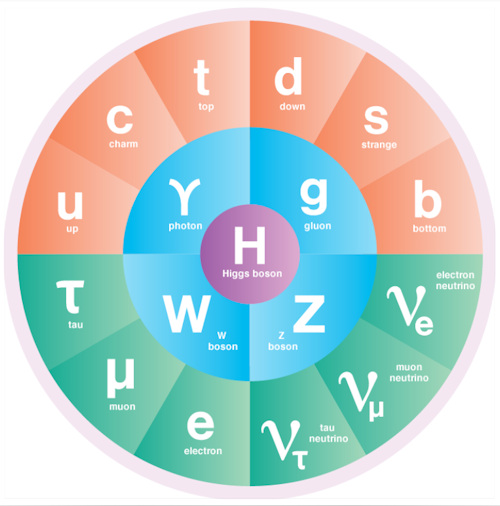
The Standard Model particle chart is shown below, with the Higgs boson at its centre.
More than 2100 users from various US institutes are registered at CERN, making the United States the laboratory's largest user community. As if in tribute to this fact, it was on American Independence Day, 4th July 2012, and with much fanfare, that the discovery of the Higgs boson was announced. Given the enormous investment in the LHC, expectations were understandably high.
Following the 2012 discovery, the LHC underwent major upgrades to explore the Higgs boson in greater detail and to search for physics beyond the Standard Model. Those searches have confirmed many of the Higgs' expected properties, while excluding a number of proposed extensions within specific energy ranges. At the same time, many fundamental questions remain unanswered, including whether the Higgs is truly elementary or part of a richer underlying structure.
One such search, led by Dmitri Denisov and colleagues at Fermilab, looked for evidence of additional Higgs bosons predicted by certain extensions of the Standard Model. Reporting the results, Denisov commented:
“We do not see the signal. If it existed, we would see it. But when we look at our data, we basically see nothing.”
The story did not end there. In another Higgs hiccup, New Scientist reported that the bad boy was "refusing to misbehave."
"Physicists have spotted the Higgs boson performing a new trick, but one that brings us no closer
to understanding the workings of fundamental particles. The Higgs boson, discovered at the CERN particle physics laboratory
near Geneva, Switzerland, in 2012, is the particle that gives all other fundamental particles mass, according to the Standard
Model of particle physics. However, despite the work of thousands of researchers around the world, nobody has been able to
figure out exactly how it does that or why some particles are more massive than others."
More than a decade after the announcement, the Higgs boson continues to raise as many questions as it answers. Some physicists have proposed that it may itself be a composite particle rather than a truly elementary one. Others continue to search for additional Higgs particles or entirely new physics beyond the Standard Model. The discovery appears not to have closed the book, but merely opened the next chapter. Dark Higgs, perhaps?
None of this is to suggest that the scientists at CERN are anything other than exceptionally talented. Quite the opposite. If nothing else, they have demonstrated an admirable ability to answer one question by uncovering half a dozen new ones. The search continues... and, one suspects, so too does the funding.
"The underlying assumptions of cosmologists today are developed with the most sophisticated mathematical methods and it is only the plasma itself which does not 'understand' how beautiful the theories are and absolutely refuses to obey them." Hannes Alfvén
"We are in a period of utter confusion!" Nobel laureate David Gross
Gravity and EM
An examination of the Electromagnetic Gravity hypothesis.
An interesting and balanced analysis from a mainstream source. All too often the idea of gravity being of EM origin is dismissed out of hand. Because electromagnetism can be shielded and gravity can't, it is generally assumed that the two forces must be irreconcilable. Such a view is clearly too simplistic, however. This article is therefore strongly recommended.
"...The equivalence of inertial
and gravitational mass implies that gravity is also
an electrical force. Before Einstein, some noted scientists
were suggesting that the gravitational force between
neutral particles might ultimately be due to electrical
polarization within the particles. In 1882, Friedrich
Zöllner wrote in the introduction to his book,
Explanation of Universal Gravitation through the Static
Action of Electricity and The General Importance of
Weber's Laws, "…we are to conclude that a
pair of electrical particles of opposite signs, i.e.
two Weberian molecular pairs attract each other. This
attraction is Gravity, it is proportional to the number
of molecular pairs." Indeed, gravity can be represented
as the sum of the radially aligned electric dipoles
formed by all subatomic particles within a charged planet
or star.
"This new electrical concept suggests
that Newton's "universal constant of gravitation,"
or "G," is a dependent variable. G depends
upon the charge distribution within a celestial body.
Highly charged objects like comets look like solid rock,
yet they have a gravitational field that suggests they
are fluff-balls. And as they discharge they suffer what
is euphemistically called "non-gravitational"
accelerations. The extreme weakness of the force of
gravity, compared to the electric force, is a measure
of the minuscule electric dipolar distortion of nucleons.
Gravity cannot be shielded by normal electrostatic shielding
because all subatomic particles within the gravitational
field respond to the dipolar distortion, whether they
are metals or non-metals.
"What about magnetism? Ampere's
law for the magnetic force between two current carrying
wires is found to be equivalent to the transverse electric
force caused by the distortion of electrons in an electric
field. This distortion causes them to form tiny collinear
electric dipoles. That is, the magnetic force is simply
another manifestation of the electric force.
"This simple electrical model of
matter has the great virtue of reducing all known forces
to a single one – the electric force. However,
it has a price. We must abandon our peculiar phobia
against a force acting at a distance. And we must give
up the notion that the speed of light is a real speed
barrier. It may seem fast to us, but on a cosmic scale
it is glacial. Imposing such a speed limit and requiring
force to be transmitted by particles would render the
universe completely incoherent. If an electron is composed
of smaller subunits of charge orbiting within the classical
radius of an electron, then the electric force must
operate at a speed far in excess of the speed of light
for the electron to remain a coherent object. In fact,
it has been calculated that if released, the subunits
of charge in the electron could travel from here to
the far side of the Andromeda galaxy in one second!
"We have direct evidence of the
superluminal action of the electric force, given that
gravity is a longitudinal electric force. Indeed, Newton's
celebrated equation requires that gravity act instantly
on the scale of the solar system. It has been calculated
that gravity must operate at a speed of at least 2x10¹⁰
times the speed of light, otherwise closely orbiting
stars would experience a torque that would sling them
apart in mere hundreds of years. Similarly, the Earth
responds to the gravitational pull of the Sun where
it is at the moment, not where the Sun was 8 minutes
ago. If this were not so, the Earth and all other planets
in the solar system would be slung into deep space within
a few thousand years. Gravity is therefore an electrical
property of matter, not a geometrical property of space.
"What is the nature of light? Einstein's
special theory of relativity was disconfirmed right
at the start by the Michelson-Morley experiment, which
showed a residual due to the æther. This was later
confirmed by far more rigorous repeats of the experiment
by Dayton Miller. But by then popular delusion and the
madness of crowds had taken hold and contrary evidence
would not be tolerated. The Dayton Miller story makes
interesting reading. If it weren't for the extraordinary
power of self-delusion, commonsense would tell us that
a wave cannot exist in nothing. So Maxwell was right,
light is a transverse electromagnetic wave moving through
a medium, the æther.
"But what is the æther? In
the vacuum of space, each cubic centimetre is teeming
with neutrinos. And since neutrinos are resonant orbiting
systems of charge, like all matter, they will respond
to the electric force by distorting to form a weak electric
dipole aligned with the electric field. The speed of
light in a vacuum is therefore a measure of the delay
in response of the neutrino to the electric force.
"What about the bending of starlight
by the Sun, which discovery raised Einstein to megastar
status? The residual found in the Michelson-Morley experiments
shows that the Earth and all ponderable bodies "drag"
the æther along with them. The bending of starlight
near the Sun is simply the effect expected of an extensive
neutrino atmosphere held to the Sun by gravity. Light
will be slowed in the denser medium – causing normal
refraction or bending of light..."
"There is no model of the theory of gravitation today, other than the mathematical form." Richard Feynman
"The machines that are first invented to perform any
particular movement are always the most complex, and succeeding artists generally
discover that with fewer wheels, with fewer principles of motion than had originally
been employed, the same effects may be more easily produced.
"The first philosophical
systems, in the same manner, are always the most complex."
Adam Smith
Plasma Aerodynamics and Boundary Layer Control
In recent decades, researchers have explored the use of plasma actuators to influence the flow of air around a surface. These devices generate a thin layer of ionized gas plasma along a wing or body surface by applying a high-voltage electric field across small electrodes embedded in the structure.
When the surrounding air becomes partially ionized, the charged particles accelerate in the electric field and transfer momentum to the neutral air molecules. This process can subtly alter the boundary layer the thin region of air that clings to the surface of a wing or vehicle.
Under certain conditions, plasma actuators have been shown to:
Delay boundary-layer separation
Reduce aerodynamic drag
Suppress turbulence
Improve lift and stall behaviour on wings
Because the effect is produced electrically rather than mechanically, plasma actuators have no moving parts and can respond rapidly to changing flow conditions. Experimental systems have been investigated for use on aircraft wings, turbine blades, and even automobile surfaces to reduce drag.
While the forces produced by present systems are relatively small, the research demonstrates that ionized gases can interact with airflow in measurable and controllable ways. In principle, such effects could allow subtle aerodynamic control without conventional flaps, control surfaces, or mechanical devices.
These developments illustrate how electromagnetic processes and aerodynamics can interact in ways that were only lightly explored in earlier decades.
The Flight of the Bumblebee
For decades, people repeated the claim that bumblebees should not be able to fly. The argument was based on simple aerodynamic calculations suggesting that their relatively small wings could not generate sufficient lift for such a comparatively large and heavy body. Those calculations, however, treated the wings much like those of a conventional aircraft. In reality, a bee's wings beat rapidly through complex motions that create unsteady vortices and other aerodynamic effects. Modern fluid dynamics has shown that these mechanisms can indeed provide sufficient lift.
Yet another, less familiar discovery has emerged. Bees are electrically charged. They generate measurable electric fields, can detect electric fields around flowers, and use electrostatic interactions during pollination. Electricity is therefore not merely present; it forms part of their sensory world.
Whether electrical forces also make any measurable contribution to flight remains an open question. At present, there is little experimental evidence that electrostatic forces provide significant lift. Even so, the discovery that insects routinely exploit electric fields demonstrates that electromagnetism plays a far greater role in biology than was once assumed. If electricity contributes so fundamentally to pollination, navigation, and sensory perception, it is at least reasonable to ask whether its influence on other aspects of insect behaviour has been fully explored.
Science advances by building models that simplify reality. Those models are often extraordinarily successful within the domains for which they were developed. Over time, however, they can become the default lens through which new observations are interpreted.
Plasma, for example, is frequently described as a conducting fluid, leading naturally to concepts such as solar winds, ion flows, plasma waves, and magnetic turbulence. These descriptions are often useful and highly predictive. Yet they may also encourage us to view fundamentally electromagnetic systems primarily through the language of fluid dynamics.
That does not mean the conventional interpretation is wrong. It does, however, raise a broader question. When a scientific framework becomes deeply established, are alternative interpretations always given equal consideration? Or do successful models sometimes become intellectual habits that quietly shape the questions we ask, and the answers we are prepared to accept?
For a related discussion of how unusual flight characteristics in nature can influence our interpretation of unidentified aerial phenomena, see Lessons from Nature.
Eric Laithwaite, Gyroscopes, and the 'Abominable Knowmen'
Eric Roberts Laithwaite 1921-1997 was a British electrical engineer and professor of engineering best known as the 'Father of Maglev' for his development of the Linear Induction Motor and Maglev rail system.
He gave a lecture at the Royal Institution which was televised by the BBC in 1974. This can still be found on YouTube, and is well worth viewing. Fascinating about this lecture was the apparent demonstration of weight loss shown by gyroscopes. Laithwaite did not claim to have invented an anti-gravity machine. He merely pointed out that the laws of Newtonian physics do not seem to apply to objects when moving like a gyroscope! All the same, following the publication of his research in this field, many people did contact him about 'antigravity' effects. He was always cautious in his responses, but nevertheless critical of those who dismiss such anomalous effects out of hand.
Laithwaite referred to such people as 'The Abominable Knowmen'. These are the people who simply 'know' that what Laithwaite highlights is 'of no interest' because it has already been 'explained'. The trouble being that explaining something away is quite different from explaining it, as the iconoclastic philosopher Charles Forte was wont to say. Laithwaite was always keen to remind people of what science is really about – observation, exploration, curiosity, wonder, and the occasional flash of insight.
The fact that an
opinion has been widely held is no evidence whatever
that it is not utterly absurd; indeed in view of the
silliness of the majority of mankind, a widespread belief
is more likely to be foolish than sensible." Bertrand
Russell
The mysterious electron
Despite
the importance of the electron, we know surprisingly little about it. For example,
we don't know whether it's a wave or a particle, as it displays properties consistent
with both (hence the term wave-particle duality) and, according to conventional
wisdom, it has no structure.
"All attempts to measure
the radius of the electron have failed! All we know is that the radius is less
than 10-18 m; that is, its radius is one hundred million times smaller than that
of the atom. All the known properties of the electron are consistent with the
assumption that its radius is zero. As far as we know, the electron has no structure."
The above is quoted from the London Science
Museum web site.
Independent New York researcher Ralph Sansbury has proposed a model in which the electron is not fundamental and indivisible, but instead composed of smaller charged constituents he termed subtrons, orbiting within the classical radius of the electron.
In this framework, simple calculations imply extremely high internal velocities far exceeding the conventional speed of light constraint if interpreted literally. Sansbury argued that such internal dynamics would imply effectively instantaneous electromagnetic cohesion at subatomic scales.
Whether or not his conclusions withstand scrutiny, the broader point is provocative: any successful theory of gravity must ultimately account for how matter maintains coherence across space. The question of action at a distance remains central to that challenge.
Biologist Rupert Sheldrake, formerly a Fellow of Clare College, Cambridge, is best known for his hypothesis of morphic fields and morphic resonance. Put simply, Sheldrake proposes that memory may be inherent in nature itself, and that self-organising systems — from crystals and plants to animals and societies — may be influenced by the accumulated patterns of similar systems that came before them.
In this view, the regularities we call the laws of nature may in some cases behave more like habits, becoming established and reinforced through repetition. Sheldrake describes this proposed influence across time as “morphic resonance.”
The idea has intriguing parallels with some of the broader themes explored on this site. Plasma Cosmology presents a universe in which apparently separate structures can form part of larger interconnected electrical systems, while morphic resonance proposes another possible level of organisation in which information and pattern may extend beyond individual objects.
The two ideas should not be confused: Plasma Cosmology does not depend upon morphic fields, nor does plasma physics provide evidence for morphic resonance. But if nature possesses deeper levels of organisation than those presently understood, Sheldrake’s hypothesis provides an interesting possibility to consider.
From the article: “The implication is that many phenomena which until now have been regarded as purely statistical in character — such as the distribution of fluctuations in the momentary rates of radioactivity measured in a sample — are somehow controlled or at least strongly influenced by an astrophysical factor...”
If radioactive-decay measurements were shown conclusively to vary with astronomical or environmental conditions, the implications could be considerable. Radioactive decay is normally treated as statistically predictable and largely independent of external influences, an assumption fundamental to radiometric dating.
The reported variations do not by themselves invalidate conventional chronologies. But they raise an interesting question: are radioactive processes quite as isolated from their wider environment as generally assumed? If astronomical or electrical conditions can measurably influence decay behaviour, their possible effects on dating methods would deserve careful investigation.
This becomes particularly interesting from a catastrophist perspective. If the Solar System has experienced periods of substantially different electromagnetic conditions in the past, as some researchers propose, assumptions of constant environmental conditions over immense periods may warrant closer examination.
“No hand can make the clock strike for me the hours that are passed.”
Lord Byron
The Diehold Foundation, Douglas Vogt, and Solar Cycles
The Diehold Foundation was founded by Douglas Vogt, who passed away in 2023. His work focused on polar reversals and ice ages — both well-established features of Earth’s geological record. Where Vogt diverged from mainstream climate explanations was in his view that long-term temperature variations are driven principally by solar cycles rather than anthropogenic CO2. This has parallels with the Electric Universe and Electric Sun models, which place greater emphasis on solar variability and electromagnetic influences than purely atmospheric narratives.
Vogt was sceptical that human-produced CO2 is the dominant climate driver. Carbon dioxide constitutes roughly 0.04% of the atmosphere, and large exchanges of CO2 occur naturally via ocean-atmosphere cycling, biological activity and volcanism. From this perspective, he questioned whether reductions in human emissions alone can meaningfully regulate climate over long timescales. While many climate scientists maintain that anthropogenic forcing plays a measurable role in recent warming, others argue that solar variability and longer cycles deserve more weight. The debate is often presented as settled, but the relative contributions of different drivers remain contested at the margins and are still actively researched.
Predictably, scepticism toward carbon-centric policy has produced a spectrum of responses — from straightforward criticism of taxation and regulation to broader institutional distrust. Some go further into speculative territory, pointing to deep underground military installations (DUMBs) as evidence that powerful actors anticipate future disruption. Whatever one makes of such claims, it is worth separating structural questions about incentives and policy from narratives that move beyond what can be demonstrated.
“In the sciences, the authority of thousands of opinions is not worth as much as one tiny spark of reason in an individual man.” Galileo Galilei
Vogt’s Solar Clock and Polar Reversals
Central to Vogt’s thesis was the idea that the Sun follows a long-term “clock cycle,” which he believed could be traced through geological and historical markers. In his model, the cycle crosses a neutral point roughly every 12,068 years, with a full oscillation of 24,136 years corresponding to two geomagnetic reversals.
On this timeline, Vogt suggested that humanity may be approaching another transition. He proposed that a polar shift could occur around 2046, potentially bringing severe climatic and geophysical disturbance. In his more dramatic descriptions, he argued that a rapid shift could coincide with a short-term disruption of Earth’s rotation, leading to catastrophic ocean displacement and widespread upheaval — an event he sometimes framed in biblical language as a “Day of Judgment.” He also maintained that preparation and mitigation could reduce the severity of some impacts.
Catastrophic cycles and end-time predictions are nothing new, and caution is warranted when precise dates are proposed. Nonetheless, the broader themes Vogt emphasised — solar variability, magnetic weakening, and geomagnetic instability — are increasingly discussed across both academic and independent research circles.
Space Weather
The work of SpaceWeatherNews.com (formerly Suspicious0bservers.org) overlaps in part with Vogt’s emphasis on solar monitoring. The organisation tracks solar flares, coronal mass ejections and geomagnetic disturbances with close attention.
In May 2023, auroras were observed at unusually low latitudes, including Spain. Some observers noted that the associated solar activity did not appear exceptional by standard flare classifications, raising questions about whether Earth’s magnetic shielding may be weakening. The geomagnetic field has shown measurable decline since the nineteenth century, with some estimates placing noticeable reduction beginning around 1850.
Whether magnetic weakening contributes meaningfully to recent warming trends — often attributed primarily to anthropogenic greenhouse forcing — remains debated. The broader question is whether increased solar variability, magnetic field variation, and long-term cycles could signal the approach of a more substantial geomagnetic transition.
At present, definitive conclusions remain elusive. What is clear is that Earth’s climate and magnetic systems are dynamic, and solar influences form an integral part of that complexity.
The Holographic Universe
One of the more intriguing ideas to emerge from modern theoretical physics is the holographic principle — the possibility that the information describing a volume of space may, in some circumstances, be represented on a lower-dimensional boundary.
The analogy comes from a hologram, in which information capable of producing an apparently three-dimensional image is encoded on a two-dimensional surface. Applied to the universe, the idea raises a remarkable question: could the reality we experience be the manifestation of information or relationships existing at a more fundamental level?
There are many interpretations of this idea, ranging from rigorous mathematical models to much broader philosophical speculation. These should not be confused. A holographic universe does not imply that reality is a computer simulation, nor does the holographic principle establish that the physical universe is literally a hologram.
Nevertheless, the broader possibility is interesting from the perspective of Plasma Cosmology. Plasma structures are inherently relational: electric currents generate magnetic fields, fields influence charged particles, and organised structures can emerge across enormous differences in scale. Nature repeatedly produces filaments, cellular structures, spirals and fractal-like forms, with similar patterns appearing across widely differing scales. This self-similarity is particularly striking in plasma, where structures produced in the laboratory can resemble phenomena observed on vastly larger cosmic scales.
None of this demonstrates that the universe is holographic. But neither does Plasma Cosmology require the universe to consist only of the mechanisms presently understood.
This distinction is important. Plasma Cosmology can accommodate a holographic universe, an æther-like substrate, or other deeper levels of physical organisation, but it does not depend upon any of them. Its central claims stand or fall upon observable plasma behaviour, laboratory experiment and astronomical evidence.
The universe may contain deeper levels of organisation than those presently visible to us. Plasma Cosmology leaves that door open without requiring us to walk through it.