"If you thought that science was certain — well, that is just an error on your part." Richard Feynman
Science and Philosophy
Skepticism
Skepticism in its original sense traces back to ancient Greece and takes seriously the limits of certainty. In that tradition, both absolute doubt and absolute certainty are treated as positions we cannot honestly defend.
In simpler terms, skepticism is a discipline of questioning our own confidence. Too often, however, “skepticism” is used to mean aggressive doubt aimed outward, while one’s own worldview is treated as settled. That is better described as pseudo-skepticism: the appearance of critical thought without the self-critique that makes it valuable. This link explores pseudo-skepticism in its many guises:
Skeptical About Skeptics
When the term is used today, we generally mean skepticism of the critical-thinking variety, where empirical evidence is required to support new ideas. That modern approach has practical strengths, but it can also drift into gatekeeping if “extraordinary claims” are defined in ways that protect prevailing assumptions.
"Philosophy is a battle against the bewitchment of our intelligence by means of language."
Wittgenstein
The history of science shows that resistance to new ideas is not always about evidence. Often it is about professional risk, intellectual investment, or the simple inertia of what feels familiar—even when contrary evidence is available.
In perhaps the most famous example, Scientific American ran an article ridiculing the alleged flights of Wilbur and Orville Wright—years after they had already flown successfully. That pseudo-skepticism rested on a prior conviction (that heavier-than-air flight was impossible) and was echoed by many scientists and the U.S. Army. Ironically, the lack of media coverage was even treated as evidence against the claim.
Of particular relevance to this site is the case of Michael Faraday. He was dismissed as a charlatan when he announced that an electric current could be generated merely by moving a magnet through a coil of wire.
"Today's scientists have substituted mathematics for experiments, and they wander off through equation after equation, and eventually build a structure which has no relation to reality." Nikola Tesla
Famous Philosophers of Science
The following philosophers were fond of discussing these problems, and the implications of their work should be clear. No scientific theory is invulnerable; if a theory is treated as untouchable, it risks becoming ideology rather than science.
"Fiction has to be plausible. Reality is under no such constraint." Anon
Falsificationism
Karl Popper (1902–1994) gave us falsificationism, a relatively simple but often misunderstood philosophical tool for demarcating between science and non-science. He laid down this methodology in his magnum opus, The Logic of Scientific Discovery (1959).
His aim was to confront the problem of induction, where only confirming instances tend to be noticed. Turning this on its head, Popper argued that a single contrary result should be enough to falsify a theory—provided the result is repeatable and the test genuinely bears on the claim.
To Popper, the terms testable, falsifiable, and scientific were closely linked. For a theory to count as scientific, it should make risky predictions and be vulnerable to being proven wrong. Popper criticized theories that leave too much ambiguity—where almost any outcome can be interpreted as “consistent.” Such theories do not add much to knowledge because they can always be saved.
A theory can be conclusively falsified, but never conclusively verified. As Popper put it: "Our knowledge can only be finite, while our ignorance must necessarily be infinite."
Science, according to Popper, proceeds by a process of “conjecture and refutation.” He promoted bold theories and noted that falsification is not necessarily a failure; it can mark genuine progress.
Popper also recognized problems with falsificationism. It is often possible to immunize a theory against falsification using ad-hoc hypotheses. Scientists are human, and can be reluctant to see cherished theories undermined. Anomalies may be ignored or minimized while the community still pays lip service to falsifiability. When that happens, the boundary between science and ideology becomes blurred.
"There are none so blind as those who have learned not to see." Michael Armstrong, Natural Philosopher
The Principle of Falsification
Philosopher Karl Popper expressed a simple but powerful idea about how science advances.
“Science progresses not by proving theories correct, but by eliminating those that fail.”
In this sense, the central question in science is not:
“How many scientists believe a theory?”
but rather:
“How well does the theory withstand attempts to falsify it?”
A scientific theory earns its credibility not through consensus, authority, or mathematical elegance, but through its ability to survive repeated and rigorous testing against observation and experiment. Theories must make clear, risky predictions that expose them to the possibility of being proven wrong.
When contradictory evidence appears, the question is not whether a theory can be preserved indefinitely through reinterpretation, auxiliary assumptions, or ad-hoc adjustments. The question is whether the theory continues to make testable predictions that could, in principle, falsify it.
In Popper’s view, the strength of a scientific theory lies precisely in its vulnerability. A theory that cannot be tested, or that can accommodate any possible outcome, may be intellectually interesting — but it tells us little about how nature actually works.
A theory that can explain everything ultimately explains nothing.
Philosopher Imre Lakatos attempted to reconcile the views of Karl Popper and Thomas Kuhn. He proposed that scientific theories do not stand alone, but exist within broader research programmes consisting of a central “hard core” protected by auxiliary hypotheses. When difficulties arise, adjustments are often made to the outer layers of the theory while the core assumptions remain intact.
Paradigm Shifts
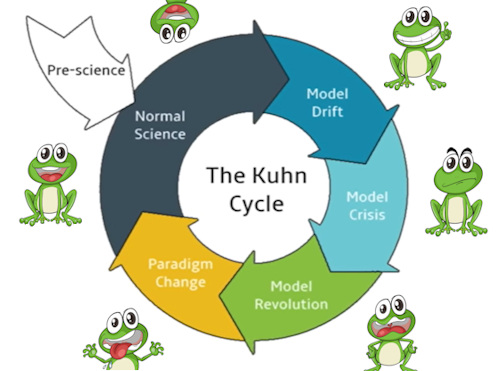
Thomas Kuhn (1922–1996) emphasized another mechanism by which knowledge changes: the paradigm shift. In The Structure of Scientific Revolutions (1962), he argued that science does not always evolve gradually toward truth, but can undergo periodic revolutions in which one framework replaces another.
For Kuhn, conjecture and refutation were not the whole story. Scientific ideas can persist despite anomalies until an alternative framework becomes compelling enough to reorganize the field. His view echoes the famous words of Max Planck (right).
Paradigm paralysis can arise when specialists become deeply invested in the prevailing framework and find it difficult to see outside it. Intelligence alone does not guarantee openness; sometimes the most capable minds are also the most committed to the formalism that made them successful.
The cooked frog analogy is often used here: put a frog in boiling water and it jumps out; put it in cool water and heat it gradually and it may fail to react in time.
"A new scientific truth does not triumph by convincing its opponents and making them see the light, but rather because its opponents eventually die, and a new generation grows up that is familiar with it." Max Planck
"There is a theory which states that if ever anyone discovers exactly what the Universe is for and why it is here, it will instantly disappear and be replaced by something even more bizarre and inexplicable. There is another theory which states that this has already happened." Douglas Adams
Distinctions Between Intellectuals and Pseudo-Intellectuals
From suppressedscience.net, by Sydney Harris, Detroit Free Press, 11/20/81
The intellectual is looking for the right questions to ask; the pseudo is giving what he claims to be the right answers.
The intellectual is evidently motivated by a disinterested love of truth; the pseudo is interested in being right, or being thought to be right, whether he is or not.
The intellectual is willing to admit that what he does not know is far greater than what he knows; the pseudo claims to know as much as can be known about the subject under consideration.
The intellectual states as good a case for his adversary as can be made out; the pseudo sets up a straw man and beats it to death for the sake of seeming superior.
The intellectual is deeply and constantly aware of the limitations of human reason; the pseudo makes a deity of reason and tries to force it into realms it cannot penetrate.
The intellectual seeks light from whatever source, realizing that ideas are no respecters of persons and turn up in the most unexpected places from the most improbable people; the pseudo accepts ideas, when he does, only from experts and specialists and certified authorities.
The intellectual advances a hypothesis that he hopes may be true; the pseudo propounds a dogma that he insists is true.
The intellectual recognizes that opposites are not always contradictory, and may indeed reinforce each other; the pseudo paints a picture in black and white, right or wrong, leaving no room for a contrary viewpoint.
The intellectual knows there are no final answers to human questions; the pseudo makes each tentative and provisional answer sound like a finality.
The intellectual is courageous in opposing majority opinion, even when it jeopardizes his position; the pseudo slavishly follows "the most reliable authorities" in his field, sneering at heresies.
The intellectual never talks down to his audience, but tries to be as clear as possible; the pseudo talks above his audience to mystify and impress them.
"In the sciences, the authority of thousands of opinions is not worth as much as one tiny spark of reason in an individual man." Galileo Galilei
"The discovery of truth is prevented more effectively, not by the false appearance things present and which mislead into error, nor directly by weakness of the reasoning powers, but by preconceived opinion, by prejudice." Arthur Schopenhauer
Why many new ideas are dismissed as “conspiracy theories”
This section also appears on the Way Forward page. The dismissal of new ideas—no matter how reasonable and empirical—is an old problem. Thomas Kuhn documented many such controversies throughout history in his masterpiece The Structure of Scientific Revolutions mentioned above. Chris Reeve examines the more recent trend for attacking new ideas by labelling them as conspiracy theories, very often by uninformed and sensational would-be opponents.
"The eye sees only what the mind is prepared to comprehend." Novelist, Robertson Davies
“Almost all people are hypnotics. The proper authority saw to it that the proper belief should be induced, and the people believed properly.” Charles Fort