Is there a simple confusion of cause and effect in popular science?
Is the movement of air and water primarily responsible for charge
separation on Earth, or do electromagnetic forces themselves play a
more fundamental role in producing movement? Could electric currents
be a prime mover behind some of the rotational, filamentary and spiral
patterns we see throughout nature and the universe?
At the level of individual particles, the electric force between two
elementary charged particles is some 1039 times stronger
than their gravitational attraction. Electromagnetism binds atoms and
molecules, governs chemistry and gives ordinary matter much of its
structure. The question is not whether electricity is powerful, but
how far its influence extends.
“And even if one regards the electric fields as merely
another postulate, it has the great advantage that it is the one
postulate which, in my view, renders all the others
unnecessary.”
C. E. R. Bruce, Electric Fields in Space,
Penguin Science, 1968
“What we call mass would appear to be nothing but an
appearance, and all inertia to be of electromagnetic
origin.”
Henri Poincaré (1854–1912), mathematician,
physicist, engineer and philosopher of science,
Science and Method, 1908
Michael Faraday transformed physics by demonstrating electromagnetic
induction: moving a magnet relative to a coil of wire could generate
an electric current. The principle ultimately gave us the electrical
generator and, through the complementary interaction between electricity
and magnetism, the electric motor. Nature makes extraordinarily effective
use of electromagnetic forces at every scale we can readily investigate.
Is there any good reason to assume that their wider role must necessarily
be small?
Faraday himself repeatedly sought a deeper connection between gravity
and electromagnetism. He understood just how profound such a connection
would be:
“...no terms could exaggerate the value of the relation
they would establish.” Michael Faraday, 1850
The great physicists of the 19th century frequently searched for
simplification and unification. Today, by contrast, physics contains
an expanding catalogue of particles, fields and theoretical entities,
some directly observed, others inferred through their predicted effects.
Complexity may ultimately be unavoidable, but history gives us good
reason to keep asking whether a simpler underlying picture has been
overlooked.
Long before the development of modern atomic theory, Wilhelm Weber
explored the possibility of connecting gravitation with electrical
forces and developed electrodynamic models of matter. Such ideas remind
us that the search for a deeper electrical unity in nature is not new.
Faraday, Weber and others were already asking versions of the same
question more than a century ago: might apparently separate forces be
different manifestations of something more fundamental?
Alfvén's Electric Universe crisis
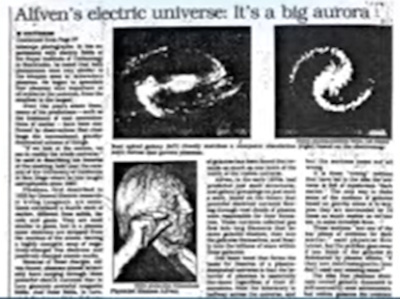
In 1989, Hannes Alfvén
had an article published in the Boston Globe, titled
Alfvén's Electric Universe. As early as 1937, he had
proposed that our galaxy contained a large-scale magnetic field and that
charged particles moved in spiral orbits within it under the influence of
electromagnetic forces. Electric currents flowing through plasma generate
magnetic fields. Alfvén, of course, is widely regarded as the father
of plasma physics and a pioneer of Plasma Cosmology.
In his 1970 Nobel lecture, Alfvén warned against relying too heavily
on idealised mathematical models of plasma without sufficient reference to
laboratory experiments and observed plasma behaviour. In his later work,
he became increasingly critical of the way some of his own earlier ideas
had been interpreted and applied, particularly the concept of
“frozen-in” magnetic fields. See
Technical I.
His later criticism of conventional astrophysics was characteristically direct:
“Students using astrophysical textbooks remain essentially
ignorant of even the existence of plasma concepts, despite the fact that
some of them have been known for half a century. The conclusion is that
astrophysics is too important to be left in the hands of astrophysicists
who have gotten their main knowledge from these textbooks. Earthbound and
space telescope data must be treated by scientists who are familiar with
laboratory and magnetospheric physics and circuit theory, and of course
with modern plasma theory.”
“We have to learn again that science without contact with experiments
is an enterprise which is likely to go completely astray into imaginary
conjecture.”
Hannes Alfvén
“It is an embarrassment that the dominant forms of matter in the
universe remain hypothetical.”
Jim Peebles, Princeton cosmologist
Particular problems
It seems no small irony that the solar system has long been used as a
visual metaphor for the atom, while the analogy is rarely reversed.
Electromagnetic forces are fundamental at the atomic scale, yet on
astronomical scales gravity is generally assumed to dominate, with
large-scale electrical effects assigned a much more limited role.
Another unresolved problem concerns the Standard Model. Although
extraordinarily successful within its domain, it does not incorporate
gravity. The discovery of a Higgs-like particle at CERN in 2012 filled
an important gap in the model, but it did not provide a quantum theory
of gravity or resolve the deeper question of how gravity relates to the
other fundamental interactions. See
Was the Higgs really
discovered in 2012?
“Gravity is not yet part of this framework, and a central
question of 21st-century particle physics is the search for a quantum
formulation of gravity that could be included in the Standard
Model.”
“There is no model of the theory of gravitation today, other than
the mathematical form.”
Richard Feynman
Quantum Theory and Relativity
Quantum theory and relativity are among the most successful theories
in modern physics, yet they remain fundamentally difficult to reconcile.
Quantum mechanics describes nature at atomic and subatomic scales,
while general relativity describes gravity and the large-scale
behaviour of the universe. Each works remarkably well within its own
domain, but attempts to bring the two within a single coherent framework
have yet to produce a generally accepted theory.
This is not to suggest that Plasma Cosmology has all the answers.
It does, however, remind us that our present description of nature is
incomplete, and that the door should remain open to alternative ideas
where established theories leave important questions unresolved.
The relationship has sometimes been illustrated by comparing relativity
with the ocean and quantum theory with its ripples. The analogy is
imperfect, but the underlying problem remains: two extraordinarily
successful descriptions of nature have yet to be reconciled at the
deepest level.
“I think I can safely say that nobody understands quantum
mechanics.”
Richard Feynman
Anomalous electromagnetic phenomena
The phenomena below confirm
that we also have much more to learn about
the nature of plasma, electricity and
magnetism. See the speculations page for
questions relating to the electron.
Maxwell's Fourth Equation
In truth, this Fourth Equation is too
obvious to be named after anybody. It
works like a mirror image of the third
equation, Gauss’ Law, which relates to
electric charge. The fourth equation says
that the sum total of a magnetic field
crossing over the surface of any sphere
must always be zero.
The trouble is, there is no known
particle that generates magnetic field the
same way an electron generates electric
field. Physicists remain hopeful of
finding one, and in anticipation they have
named it the magnetic monopole. However,
as yet they have found absolutely nothing.
If magnetic monopoles are ever found,
then the fourth equation will have to be
modified to include magnetic charge.
Faraday’s Law will also have to be
modified to include magnetic current
(magnetic monopoles flowing), just as
Ampere’s Law includes electric current
(electrons flowing).
To visualise this problem, imagine a
sphere with a magnet inside. This law says
that for every bit of magnetic field going
out of the sphere, there must be an equal
amount of magnetic field going back into
the sphere. This is the same thing as
saying every magnet must have both a north
and a south pole. If you could cut a
magnet in half and have just a north pole,
you'd have just found the first magnetic
monopole!
This is one of the great mysteries of
physics and cosmology. Why, when the
universe was created, did we get trillions
of electrons, but, as far as we know, not
a single magnetic monopole?
"The
phenomena of electrical discharge are
exceedingly important, and when they are
better understood they will probably throw
great light on the nature of electricity as
well as on the nature of gases and of the
medium pervading space." James Clerk
Maxwell, Treatise on Electricity and
Magnetism.
Gerald Pollack on Electric Water
Water has many remarkable properties. Gerald Pollack's research explores
an electrical dimension that receives surprisingly little attention in
conventional descriptions of water. His experiments indicate that water
adjacent to hydrophilic surfaces can form ordered regions in which charge
separation occurs, creating measurable electrical effects. This raises
intriguing questions about the role of electricity in water, biological
systems and nature more generally.
“What I am going to tell you about is what we teach our physics
students in the third or fourth year of graduate school... It is my task
to convince you not to turn away because you don't understand it. You see
my physics students don't understand it... That is because I don't
understand it.”
Richard Feynman
Morphic Resonance
Rupert Sheldrake is a biologist and author best known for his ideas on
morphic resonance and morphic fields. He proposes that patterns in nature
may be influenced by a kind of collective memory, leading to a vision of
a living, developing universe in which the habits of nature themselves
may evolve.
Here is a link to his thought-provoking talk
Science Set Free
— ten dogmas of modern science, presented at the 2013 EU conference.
An earlier TEDx version of Sheldrake's talk became the centre of a major
dispute after TED removed it from the TEDx YouTube channel following
complaints about its scientific content. The resulting debate raised an
important question: where should science draw the line between legitimate
criticism and the exclusion of ideas that challenge established thinking?
The Hessdalen Lights
Various explanations have been proposed for the mysterious lights observed
in the Hessdalen valley in Norway, ranging from misidentified conventional
phenomena to unusual atmospheric and electromagnetic processes. The
luminous phenomena themselves are real enough and have been repeatedly
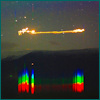
observed, photographed and studied. See a typical image, right.
Electromagnetic explanations are particularly intriguing. The local geology
contains crystalline and quartz-rich rocks capable of producing electrical
effects when subjected to stress. Could charge generated within the geology
help ionise the surrounding air? Another proposed mechanism involves
ionised air and dust forming clusters of charged particles — in other
words, a form of dusty plasma.
Whatever the precise mechanism, Hessdalen demonstrates that unusual
luminous phenomena can occur naturally in the atmosphere and that
electricity, geology and plasma may interact in ways that are still not
fully understood.
Ball Lightning
Ball lightning is one of the more mysterious electrical phenomena
associated with thunderstorms. Numerous eyewitness reports describe
luminous, roughly spherical objects that can persist for several seconds,
drift through the air and sometimes appear following an ordinary lightning
strike.
For many years, some scientists dismissed such reports as optical
after-images or misidentified conventional phenomena. Today, ball lightning
is taken much more seriously as a genuine physical phenomenon, although
there is still no generally accepted explanation for how it forms or
persists. Plasma, electromagnetic, chemical and microwave mechanisms have
all been investigated. Whatever the final explanation, electricity is
clearly central to the phenomenon.
Saint Elmo's Fire
In September 1949, William Sanborn was standing near a marsh in Yellowstone
National Park when he reported seeing a hazy patch of blue light sweep
towards him. He estimated that it was more than one hundred feet wide and
almost a thousand feet long. Sanborn could feel his scalp tingle and
described the snapping of tiny sparks as he brushed his hair with his hand,
yet received no shock when touching objects on the ground or outside his car.
Exactly what Sanborn experienced is unknown, but aspects of the account
strongly resemble atmospheric electrical phenomena such as Saint Elmo's
Fire — a luminous electrical discharge that can appear around the
masts of ships, aircraft structures and other elevated or pointed objects
when the surrounding electric field becomes sufficiently strong.
Electrical and luminous phenomena have also been reported in association
with earthquakes and periods of geological stress. Yellowstone is one of
the most geologically active regions on Earth, making Sanborn's account
particularly interesting in considering the connections between geology,
atmospheric electricity and luminous phenomena.
“Today's scientists have substituted mathematics for experiments,
and they wander off through equation after equation, and eventually build
a structure which has no relation to reality.”
Nikola Tesla