The following introduction to some technical terms should provide a reasonable insight into plasma
physics. An underlying simplicity seems to beckon even while many questions remain, and
a picture drastically different from the traditional view of the universe begins to emerge.
A fundamental question in Plasma Cosmology concerns the origin of electric fields. Critics often argue that separating
enough positive and negative charge to influence stars or galaxies would require an impossibly large amount of energy. Since
gravity acts on electrically neutral matter, they conclude that gravity must dominate cosmic evolution.
At first glance, the objection seems compelling.
But it rests on a hidden assumption: that the universe begins as electrically neutral gas.
Plasma Cosmology begins from a different observation.
Almost all visible matter in the universe exists as plasma — an ionised state in which electrons and positive ions can move independently. Neutral gas is the exception, not the rule.
This distinction is crucial.
Electrons are approximately 1,836 times less massive than protons. Consequently, almost any disturbance — gravitational, magnetic, electrical, thermal, mechanical, or radiative — affects electrons and ions differently. Perfect neutrality therefore exists only as a large-scale approximation. On smaller scales, tiny departures from neutrality arise naturally and continuously.
Those departures need not be large.
An extraordinarily small excess of electrons or ions within a vast volume of plasma is sufficient to establish an
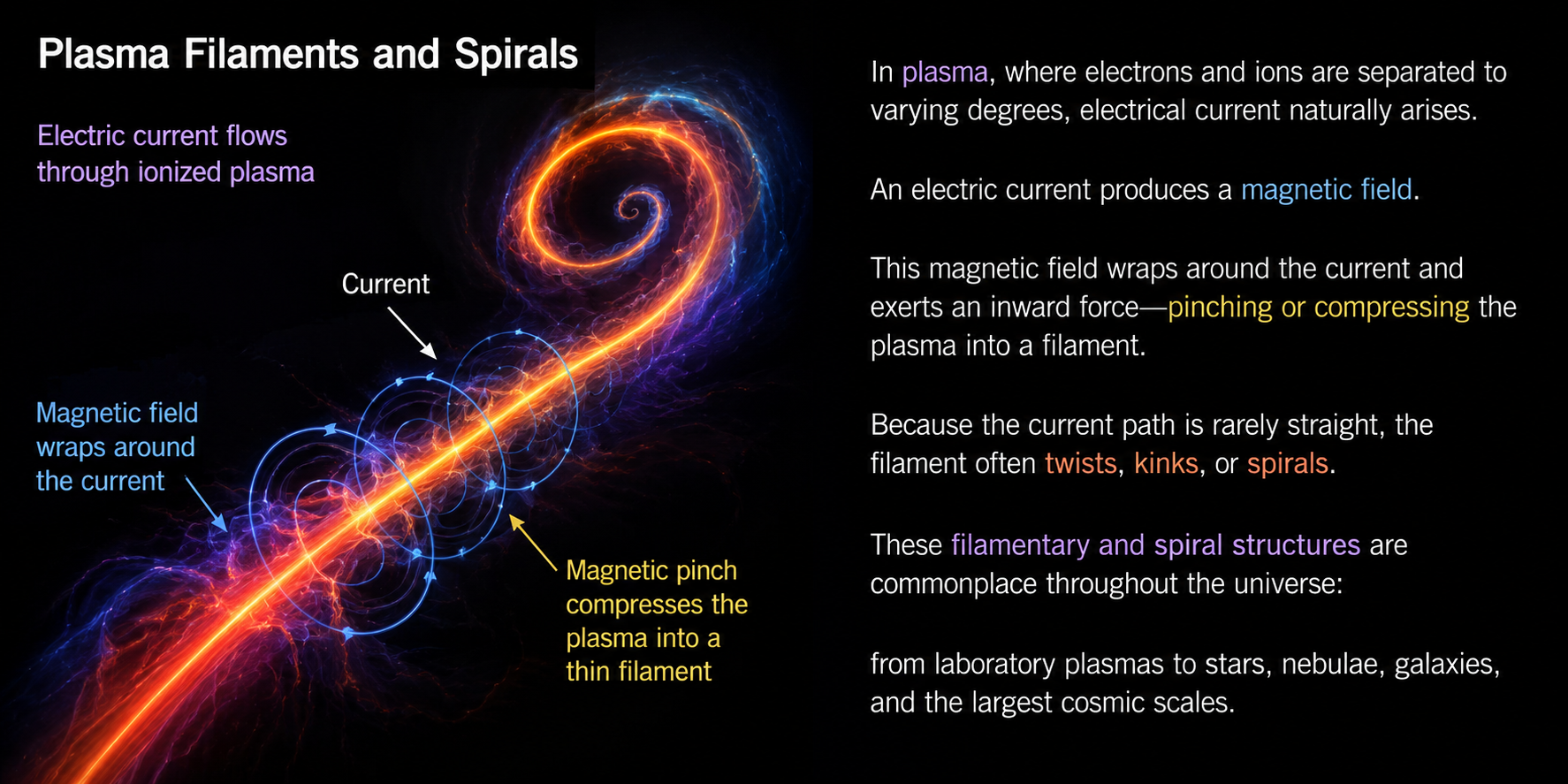
electric field. In a highly conductive plasma, even tiny departures from perfect neutrality can drive electric currents
that may extend over immense distances. Those currents generate magnetic fields, which in turn influence neighbouring
currents, producing the familiar self-organising behaviour observed throughout plasma physics: filaments, double layers,
pinches, vortices, and instabilities.
These are not merely speculative concepts. Such processes are routinely observed in laboratory plasmas, in
Earth’s aurora, in the solar wind, within planetary magnetospheres, and throughout interplanetary and interstellar
space.
The question, therefore, is not necessarily how to create charge separation from perfectly neutral matter. The
universe is already ionised. The more relevant question is how naturally occurring charge imbalances evolve, organise
themselves into currents, and ultimately transfer or dissipate their energy.
From this perspective, the universe does not require a mechanism to become electrical.
It already is.
Gravity undoubtedly plays an important role, particularly in the motion of massive bodies. But in a universe
composed predominantly of plasma, electromagnetic forces cannot simply be ignored. They are an intrinsic consequence
of the medium itself.
Plasma is ionised
Electrons and ions can move independently
Electrons are mobile
They respond more readily than massive ions
Tiny imbalances matter
Small departures from neutrality can establish electric fields
Electric fields drive currents
Currents generate magnetic fields and organise plasma
Measuring Electrical Differentials in Space
A second question naturally follows: If space is electrically active, where are the voltages? Why do we not measure enormous potential differences between planets or stars? Why are there no visible sparks crossing the void?
This is a reasonable question — but it assumes that voltage in space should behave like voltage across two copper terminals on a laboratory bench.
Here on Earth, we live inside a persistent electric field. In fair-weather conditions, the atmosphere maintains a vertical potential gradient of roughly 100 volts per metre near the surface. At head height, the electric potential may differ from the ground by approximately a hundred volts. Yet we feel nothing. There are no continuous discharges between our shoes and our scalp.
The answer is straightforward: voltage alone is not necessarily dramatic. What produces an observable physical effect is current — the movement of charge. The atmosphere is weakly conductive, charges redistribute, and bodies tend to equilibrate with their surroundings. A substantial potential difference can exist quietly when current density is low.
Space plasma behaves similarly — though on a far grander scale.
Plasma is described as quasi-neutral: the densities of positive and negative charges are nearly equal on average. Large, sustained charge separations are difficult to maintain because plasma is highly conductive, especially along magnetic field lines. Electric fields therefore tend to organise into structures such as double layers, sheaths, and boundary regions rather than appearing simply as static differentials across vast empty gaps.
This makes the idea of measuring a “voltage between planets” more subtle than it first appears. A voltmeter requires two reference points and a conductive path. In space, the measuring instrument and the spacecraft that carries it become part of the electrical system.
Spacecraft routinely charge relative to the surrounding plasma — sometimes to hundreds or even thousands of volts — depending on solar illumination, particle populations, and local plasma conditions. Electric fields are indeed measured in space, but they are often local, dynamic, and embedded within a conducting medium that continuously redistributes charge.
The absence of an easily defined planetary-scale voltage difference does not imply the absence of electrical structure. It reflects the difficulty of defining absolute electrical potential within a quasi-neutral, magnetised plasma.
An instructive example is the Tethered Satellite System mission, TSS-1R, conducted jointly by NASA and the Italian Space Agency in 1996. A conducting tether nearly 20 kilometres long was deployed from the Space Shuttle into low Earth orbit. As it moved through Earth’s magnetic field and ionospheric plasma, it generated an electromotive force of roughly 3,500 volts, with currents approaching one ampere. The tether ultimately failed following insulation breakdown and arcing.
The lesson was not exotic. It confirmed well-established electrodynamics: motion through a magnetised plasma can generate significant potentials and currents. Space is not electrically inert. Under suitable conditions, conductive structures interacting with plasma produce measurable electrical effects.
Related discussions of plasma–body interaction in cometary environments can be found in the section on Electric Comets.
The key point is not that “space is full of sparks,” but that substantial potentials can arise naturally in orbital and plasma environments — often distributed, regulated, and structured within plasma dynamics rather than expressed as dramatic static discharges.
Modern cosmology explains large-scale structure primarily through gravity, curvature, and collapse. Electric fields are acknowledged locally — in magnetospheres, auroras, and solar-wind interactions — yet they are often assumed to be secondary at cosmic scales because sustained static charge separations appear unlikely.
But plasma physics offers a more nuanced picture. Electric fields need not manifest as simple, static voltage gaps. They may be filamentary, confined within double layers, or sustained by currents flowing through vast conducting media. The challenge is not merely measuring voltage; it is recognising that, in plasma environments, structure and electromagnetism are inseparable.
While this does not, by itself, prove that galaxies are powered by intergalactic currents, nor does it negate gravitational theory, it challenges the assumption that electrical effects must be negligible at cosmic scales. Difficulty of measurement is not evidence of absence. In plasma environments, quiet fields and distributed currents can organise structure without announcing themselves through dramatic discharges.
In a conducting universe, voltage does not always shout. Sometimes it is distributed — mediated by plasma, structured by magnetism, and revealed only when we place a conductor in its path.
This naturally raises another common question: if plasma screens electric fields over the Debye length, how can electrical phenomena operate across astronomical distances?
References
Rycroft, M.J., et al. (2008). The global atmospheric electric circuit. Reviews of Geophysics.
Chen, F.F. Introduction to Plasma Physics and Controlled Fusion.
NASA SP-1998-208834. The Tethered Satellite System (TSS-1R) Mission Report.
Debye Length: A Common Misconception
Closely related to the question of charge separation is the concept of the Debye length. Critics sometimes argue that
because electrostatic potentials are screened over approximately one Debye length, electrical phenomena cannot operate on
astronomical scales.
This misunderstands what the Debye length actually describes.
The Debye length is the characteristic screening length of a plasma. It is not a fixed distance but a property of the plasma
itself, varying with parameters such as its density and temperature. It describes the distance over which a static electric
potential, arising from a local charge imbalance, is screened by the redistribution of free charges. It does not place a
limit on electric currents, magnetic fields, electromagnetic waves, or the collective behaviour of plasma.
Most cosmic plasmas are quasi-neutral, meaning that positive and negative charges remain almost perfectly balanced overall.
Yet electrically neutral plasmas can still sustain electric currents over enormous distances. Those currents generate magnetic
fields, organise plasma into filamentary structures, produce double layers, and transport energy throughout the cosmos.
Confusing the Debye length with the maximum distance over which electrical phenomena can operate is rather like confusing
the electric field between the plates of a capacitor with the length of a current-carrying wire. The
former depends upon a static separation of charge; the latter does not. A metal wire remains electrically neutral
overall, yet it can carry an electric current over hundreds or even thousands of kilometres.
Electrical neutrality does not imply electrical inactivity.
It simply means that positive and negative charges remain almost perfectly
balanced while current and energy continue to flow. Likewise, a quasi-neutral cosmic plasma can sustain vast
electric currents and the magnetic fields they generate over astronomical distances.
In other words, Debye shielding prevents large-scale static charge separation — not large-scale electrodynamics.
This distinction is fundamental. Confusing electrostatics with plasma electrodynamics has led to the widespread but mistaken
belief that electromagnetic processes are confined to microscopic scales. Laboratory experiments, spacecraft observations, and
plasma theory demonstrate otherwise.
The Debye length is named after the Dutch physicist Peter Debye, who introduced the concept in the early 1920s while
studying the electrostatic behaviour of electrolytes. Plasma physicists later recognised that the same mathematics applies
to ionised gases. The Debye length therefore originated as a description of electrostatic screening, not as a general limit
on electric currents or electromagnetic phenomena.
Charge separation
Limited by the Debye length
Electric currents
Not limited by the Debye length
Magnetic fields
Produced by electric currents
Filaments, double layers, Birkeland currents, plasma-focus effects, and electromagnetic waves
Can extend over enormous distances
Closely related to this misunderstanding is another simplification inherited from ideal magnetohydrodynamics: the
notion of "frozen-in magnetic fields."
Frozen-in Magnetic Fields: Another Common Misconception
The myth of "frozen-in magnetic fields" still occasionally appears in mainstream
discussions, despite Hannes Alfvén spending much of his later career explaining why the concept is often misused.
The idea originated as a useful mathematical simplification. Under the assumptions of ideal magnetohydrodynamics (MHD),
where a plasma is treated as a perfect electrical conductor, magnetic field lines are said to be "frozen" into the
plasma and move with it. Alfvén himself introduced this concept as a pedagogical tool to simplify certain calculations.
However, as the theory became widely adopted, many researchers began treating what had started as a useful simplification as
though it were a physical law rather than a mathematical convenience. Alfvén later expressed regret at this development,
repeatedly warning that real plasmas do not always satisfy the assumptions of ideal MHD and that the indiscriminate use
of the frozen-in approximation could obstruct a proper understanding of plasma behaviour. In his later work, he strongly
criticised the literal interpretation of magnetic field lines and the widespread misapplication of the approximation.
The basic technical reason for the misconception lies in these assumptions. Under ideal MHD, electrical resistivity is
neglected and the electric field in the plasma's own moving frame vanishes. Magnetic flux is then carried with the bulk
plasma flow, giving rise to the familiar "frozen-in" approximation.
Real plasmas, however, are never perfect conductors.
As Alfvén pointed out, including in his Nobel Prize lecture in 1970, electrical conductivity depends
not only on the mobility of charge carriers but also on their density. In a diffuse cosmic plasma, electrons and
ions move very freely, yet their concentration may be extremely low. Consequently, finite electric fields and voltage
differences can exist within plasmas, allowing currents, double layers, magnetic reconnection and many other electrodynamic
phenomena that ideal MHD either neglects or cannot adequately describe.
Although plasmas are often excellent conductors, they are never perfect conductors. The "frozen-in" approximation may
be useful under certain conditions, but it is not a universal description of plasma behaviour. As Alfvén himself repeatedly
emphasised, confusing a convenient mathematical approximation with physical reality has led to decades of misunderstanding
in plasma physics.
"Never attribute to malice that which can be adequately explained by stupidity, but don't rule out malice." Heinlein's Razor
The Solar Wind
The Earth's magnetic field acts rather like a protective cocoon. Flowing over and around it is the solar wind — the dilute but persistent stream of plasma, made up of protons, electrons, and other ions, emitted by the Sun. This plasma flow, together with its associated electromagnetic fields, distorts the Earth's own field, compressing it on the dayside and stretching it into a long tail on the nightside. The resulting structure is known as the magnetosphere.
Because the Sun is understood to emit roughly equal quantities of positive and negative charge, the solar wind is generally described in mainstream astronomy as electrically neutral. From an electrical point of view, however, this is misleading. A plasma may be quasi-neutral overall while still carrying organised electrical currents. In that sense, the solar wind is not electrically insignificant, but part of a vast and active electrical environment. Terms such as solar wind and solar radiation tend to obscure this fact, reflecting the broader reluctance to acknowledge the central role of electricity in space.
Plasmas also interact with the extensive magnetic fields of the solar system, and when conducting fluids or plasmas move through a magnetic field, a dynamo effect can arise. The electrical energy needed to drive the current is taken from relative motion. This is entirely consistent with the laws of physics: if a closed circuit exists, and part of it moves through a magnetic field while other parts do not, an electric current will be generated. That is the basic principle behind a dynamo.
Magnetospheres
Magnetic forces play only a subtle role in everyday life, typically requiring sensitive instruments — such as a compass needle — to be detected. This is largely because the materials we encounter, from the ground beneath our feet to the air we breathe, are electrically neutral overall, masking the presence of underlying electrical activity.
At altitudes of around 60 miles (100 kilometres) and above, however, the situation changes fundamentally. Here, the outer fringes of the atmosphere are dominated by plasma — ionised, electrically active matter — which responds not passively, but dynamically, to electromagnetic forces. Charged particles are guided, accelerated, and confined by the Earth's magnetic field, forming vast, structured regions of activity. These are not static fields, but components of an active electrical system.
The intensity and complexity of this environment came as one of the earliest surprises of the space age. What had been assumed to be a relatively quiet, magnetically dominated region was revealed instead to be highly dynamic and electrically active. The immense scale of planetary magnetospheres — extending tens or even hundreds of planetary radii — further underscores the point. Such structures are not easily reconciled with purely gravitational or passive magnetic models, but are entirely consistent with the known behaviour of plasma in large-scale electromagnetic systems.
Magnetotails
In contrast to the dayside of the magnetosphere — compressed and confined by the solar wind — the nightside is drawn out into a long, tapering structure known as the magnetotail. Far from being a passive extension, this region is highly dynamic, with ions and electrons continually accelerated and redistributed. The magnetotail serves as a primary energy reservoir for auroral activity, feeding the spectacular displays of the polar aurora.
This behaviour is not unique to Earth. The plasma environment of Venus, for example, forms an immense tail that can extend tens of millions of kilometres into space — in some configurations stretching far enough to approach Earth's orbit during close planetary alignments. Such scales highlight the extent to which planetary environments are embedded within, and shaped by, a wider plasma system.
Spacecraft observations have also revealed filamentary, “string-like” structures within these tails — features long anticipated by early pioneers such as Kristian Birkeland. These structures are consistent with the tendency of electric currents in plasma to organise into filaments, a behaviour well established in laboratory plasma experiments. What was once unexpected is now increasingly recognised as a natural consequence of plasma dynamics in an electromagnetic environment.
Birkeland currents
Magnetic disturbances are most commonly observed during auroral displays, where they are strongest in high-latitude regions and diminish towards the equator. This spatial pattern strongly suggests the presence of electric currents flowing in near-Earth space. Currents, by their very nature, require closed circuits. Kristian Birkeland proposed that these currents flow along magnetic field lines from space into the upper atmosphere at one end of an auroral arc, and return to space at the other, forming continuous loops and flowing parallel to the Earth's surface where appropriate.
Birkeland first advanced this idea following his Arctic expeditions in the early 20th century. At the time, it was considered speculative. Decades later, however, it received direct confirmation. In 1973, the U.S. Naval Research Laboratory satellite Triad detected vast sheets of electric current aligned with the auroral zones — flowing downward on the morning side and upward on the evening side, precisely as Birkeland had predicted. Each of these current sheets typically carries on the order of a million amperes or more.
Such currents are not confined to Earth. Enormous Birkeland currents connecting Jupiter and its moon Io were recorded by the Voyager spacecraft in 1979, demonstrating that these electrical connections operate on planetary scales.
On even larger scales, filamentary current structures have been identified near the centre of the Milky Way. In 1984, Farhad Yusef-Zadeh, Don Chance, and Mark Morris, using the Very Large Array radio telescope, discovered an immense arc of radio emission stretching roughly 120 light-years. This structure consists of narrow, elongated filaments — typically a few light-years wide — running its full length. The associated magnetic fields were found to be far stronger than previously expected on such scales, yet strikingly similar in form to those produced in plasma simulations involving current-carrying filaments.
Current modes
Electric currents in plasma occur in three primary modes — dark, glow, and arc — depending on voltage and charge density. In laboratory gas-discharge tubes, these parameters vary nonlinearly between electrodes, producing alternating regions of darkness and luminosity. The high-energy arc mode, in particular, is widely used in industry for cutting and precision machining.
The plasma sheath of Venus, mentioned earlier, is thought to operate predominantly in dark mode — a regime that carries current without significant visible emission.
Z-pinches
The plasma universe is characterised by vast, filamentary currents composed of moving electrons and ions. These currents tend to organise into twisting, corkscrew-like structures, shaped by the magnetic fields they generate around themselves. This self-constriction is known as the pinch effect.
At close range, such filaments can repel or interact in complex ways, but under the right conditions they will begin to spiral around one another. As they do, the magnetic forces between them can compress any intervening material — ionised or otherwise — concentrating matter along the axis of interaction. This process is referred to as a Z-pinch.
Much of this activity remains invisible at a distance. Like the Birkeland currents surrounding the Earth — only revealed through auroral discharge — these filamentary structures often become apparent only when energy is released in visible form.
Doubleness
The tendency for current-carrying filaments to interact in pairs is a well-recognised feature of plasma behaviour, sometimes referred to as “doubleness.”
This behaviour follows directly from Ampère’s Law (or equivalently the Biot–Savart law): parallel currents flowing in the same direction attract, while currents in opposite directions repel. Unlike gravity — which is always attractive and decreases with the square of distance — electromagnetic interactions can both attract and repel, and their effects can extend over far greater ranges under the right conditions.
Electromagnetic force strength
While all matter is subject to gravity, plasma is more strongly affected by EM forces, as is to be expected given its constituent parts — negatively charged electrons and positively charged ions. In fact, the EM force is 10^39 times as strong! Plasma displays structures and motions that are far more complex than those found in neutral solids, liquids, and gases. It has a tendency to form the cellular and filamentary structures under discussion.
"...But perhaps the most important characteristic of electromagnetism is that it obeys the longest-range force law in the universe."
"When two or more non-plasma bodies interact gravitationally, their force law varies inversely as the square of the distance between them; 1/4 the pull if they are 2 arbitrary measurement units apart, 1/9 the pull for a distance of 3 units apart, 1/16 the pull for 4 units apart, and so on."
"When plasmas, say streams of charged particles, interact electromagnetically, their force law varies inversely as the distance between them, 1/2 the pull if they are 2 arbitrary measurement units apart, 1/3 the pull for a distance of 3 units apart, 1/4 the pull for 4 units apart, and so on. So at 4 arbitrary distance units apart, the electromagnetic force is 4 times greater than that of gravitation, relatively speaking, and at 100 units apart, the electromagnetic force is 100 times that of gravitation."
"Moreover, the electromagnetic force can be repulsive if the streams in interaction are flowing in opposite directions. Thus immense plasma streams measured in megaparsecs, carrying galaxies and stars, can appear to be falling towards nothing when they are actually repelling..."
"The underlying assumptions of cosmologists today are developed with the most sophisticated mathematical methods and it is only the plasma itself which does not 'understand' how beautiful the theories are and absolutely refuses to obey them." Hannes Alfvén
Double Layers
Plasma sheaths were discovered by Langmuir in his laboratory, and are now called double layers.
DLs refer to one of the most important properties of any electrical plasma — its ability to form electrically isolated sections or cells. Because plasma is an outstanding conductor and cannot sustain a high electric field, it self-organises to form a protective sheath (Double Layer) across which most of the electric field is concentrated and where most of the electrical energy is stored (they can act very much like capacitors).
When a foreign object is inserted into a plasma, a DL will form around it, shielding it from the main plasma. This effect makes it difficult to insert voltage sensing probes into a plasma in order to measure any electric potential at a specific location.
Double layers may break down with an explosive release of electrical energy. Hannes Alfvén first suggested that billions of volts could exist across a typical solar flare DL.
Astrophysicists who map magnetic fields and assume there's no electricity in space (or little of any consequence) seem, somewhat inexplicably, to be unaware of their existence. They resort to positing any number of mechanical devices from 'magnetic reconnection' to 'frozen-in magnetic field lines' and more.
"In the beginning was the Plasma." Hannes Alfvén
'Magnetic reconnection'
Like the myth of 'frozen-in magnetic fields', Magnetic Reconnection is another colourful invention of conventional astronomy. It also attempts to account for anomalies arising from the misconception that electric currents do not flow in space.
In reality it is a well-understood plasma phenomenon, relating to exploding double layers and electric discharge. Astronomers have noticed that when magnetic reconnection occurs, there seem to be regions of electron-depleted space associated with it (electric currents). They have also noticed that a two-layer flow of particles is created that speeds the release of energy (double layers).
Don Scott, a retired professor of electrical engineering, explains the issues in more detail here
'Magnetars'
Magnetars are mathematical models of stars based on 'frozen-in' magnetic fields and 'magnetic reconnection'. Need we say more? The maths may be correct, but this does not guarantee that the models reflect reality.
Plasma cosmologists know that magnetic fields do not stand alone — they are induced by electric currents. There must be an intense electric current feeding the magnetar, and this current must be part of a circuit, as all electric circuits must be closed.
"Magnetic Reconnection is pseudo-science." Hannes Alfvén
Power generation
Because plasmas are good, but not perfect, conductors, they are similar to wires in their ability to carry electrical current. It is well known that if any conductor cuts through a magnetic field, a current will flow in that conductor. This is how electrical generators and alternators work.
If there is any relative motion between a cosmic plasma, say in the arm of a galaxy, and a magnetic field in that same location, currents will flow in the plasma. These currents will, in turn, produce their own magnetic fields.
In 1986, Hannes Alfvén postulated electrical models on both galactic and solar scales. Physicist Wal Thornhill has pointed out that Alfvén's circuits are really scaled-up versions of the familiar homopolar motor that serves as the watt-hour meter in many homes. Also, more recently, the interaction of the moon Io with the giant planet Jupiter has been likened to a dynamo.
There is still some discussion as to whether galaxies require electrical power from external sources, but who can now reasonably deny that vast currents flow throughout space? For how much longer can this simple fact be overlooked and denied?
Granted, electric currents in space may be more difficult to measure than magnetic fields, but the 'truth is out there'.
"In order to understand the phenomena in a certain plasma region, it is necessary to map not only the magnetic but also the electric field and the electric currents." Hannes Alfvén
Scaling Plasmas
Plasma phenomena are scalable. Their electrical and physical properties remain the same, independent of the size of the plasma. In a laboratory plasma, of course, things happen much more quickly than on, say, galaxy scales, but the phenomena are identical — they obey the same laws of physics.
In other words we can make accurate models of cosmic-scale plasma behaviour in the lab, and generate effects that mimic those observed in space. It has been demonstrated that plasma phenomena can be scaled to fourteen orders of magnitude. (Alfvén hypothesised that they can be scaled to 28 orders or more!)
Electric currents flowing in plasmas produce most of the observed astronomical phenomena that remain inexplicable if we assume gravity and magnetism to be the only forces at work.
Plasma simulations
A world-renowned electrical engineer, Dr Anthony C. Perratt — a graduate student of Nobel Prize winner Hannes Alfvén — has worked on plasma simulations for many years. See the links page for further details of this leading light in plasma physics.
He has utilised supercomputing capabilities to apply the Maxwell-Lorentz equations (the basic laws governing the forces and interactions of electric and magnetic fields) to huge ensembles of charged particles. He calls this PIC - Particle In Cell simulation. The results are almost indistinguishable from images of actual galaxies.
Peratt Instabilities
One of the latest and most important discoveries. These dynamic effects are observed to occur in intense Birkeland currents, arc discharges in plasma torches, Z-pinched plasma filaments, and high-energy electrical discharges. The instability takes on the shape of a column of axially symmetric toroids or spheroids that remain in a semi-stable state until disruption. These instabilities can also take on a sawtooth structure with a violent snaking motion.
Magnetohydrodynamics
The study of the dynamics of electrically-conducting fluids, one of many fields pioneered by Alfvén, and perhaps one of his better known contributions within mainstream circles.