 | |
|
|
Technical overview II
|
|
|
| |
|
|
|
|
|
|
| Dr Charles Bruce FIEE, FIP, FRAS |
|
|
| |
|
|
|
Dr Charles Bruce was a specialist in high-voltage electrical engineering and a Fellow of the Royal Astronomical
Society. In the 1940s, he advanced a remarkable proposal that remains largely overlooked by mainstream astronomy: that many energetic phenomena
in space are electrical in nature.
Bruce identified cosmic jets, solar flares, magnetic fields, and extreme temperatures as manifestations of
electrical discharge processes. In doing so, he offered an early and important foundation for the electrodynamic view of the universe.
"And even if one regards the electric
fields as merely another postulate, it has the great
advantage that it is the one postulate which, in my
view, renders all the others unnecessary."
C. E.
R Bruce, Electric Fields in Space, Penguin Science,
1968
Bruce also interpreted the striking bipolar planetary nebula shown in the heading image above as an electrical phenomenon.
|
|
 |
| |
|
|
| The Electric Sky, Don Scott |
|
 |
| |
|
|
Don Scott is a retired Professor of Electrical Engineering with a long-standing interest in astronomy and cosmology.
Published in late 2006, The Electric Sky presents the principles of plasma cosmology and the electrodynamic view of the
universe in a clear and accessible style. Combining sound science with straightforward explanations, it is a book that can be appreciated by both
newcomers and experienced readers alike. It also provides a thoughtful challenge to the conventional view that gravity alone
is responsible for shaping the cosmos.
Update (2022): Don Scott's latest book, The Interconnected Cosmos, is also available.
|
|
| |
|
|
| Plasma Focus and Compact Energetic Activity |
|
|
| | | |
|
One of the most accessible laboratory analogues for compact energetic behaviour in space is the plasma focus device (often referred to as a "plasma gun"). In such a device, a bank of capacitors drives a discharge between coaxial electrodes, forming a self-organised plasma structure called a plasmoid. Under the right conditions, these plasmoids collapse and emit tightly collimated plasma flows along the axis.
This behaviour — filaments, pinches, plasmoids and jets — is a natural outcome of electromagnetic structure in plasmas, and is observed across scales from laboratory devices to astrophysical jets.
"Active galactic nuclei (AGNs) release vast amounts of energy, whose ultimate source is a supermassive black hole in the galactic nucleus. In so-called radio-loud AGNs, two relativistic jets of plasma emanate from the nucleus, presumably along the rotational axis of the black hole."
Denise C. Gabuzda, Matt Nagle, Naomi Roche — The Jets of AGN as Giant Co-axial Cables
Even within mainstream astrophysics, plasma jets are recognised as fundamental structures. What differs is the interpretation of their source.
For a fuller discussion of how plasma focus behaviour, plasmoids, and electromagnetic structure relate to the conventional concept of black holes — and why this matters for interpreting compact energetic objects in the sky — see:
Black Holes — Plasma Focus and the Problem of Interpretation
Understanding plasma mechanisms is a key part of interpreting the true nature of compact energetic structures in the universe.
|
|
 |
| |
| Above. Looking down the barrel of a plasma focus gun. |
| |
 |
| |
| Above. NGC 6751 — collimated morphology at a larger scale. |
|
| | | |
| Intergalactic Plasma Circuits |
|
|
| |
|
|
|
Advances in astronomical imaging have revealed remarkably faint structures linking galaxies within the Virgo Cluster. Researchers describe them as cocoons, plumes, and streamers — delicate features that appear to trace previously unseen connections between neighbouring galaxies.
From the perspective of plasma cosmology, these structures are particularly intriguing. They resemble the filamentary plasma sheaths and Birkeland currents long predicted by electrodynamic models of the universe. Could these observations represent large-scale plasma circuits linking galaxies across intergalactic space?
In laboratory plasmas, the pinch effect naturally organises current-carrying plasma into filaments. These filaments can attract, repel, twist around one another, and transport energy over great distances. Plasma cosmology proposes that similar processes may operate on vastly larger scales, influencing the formation and evolution of galaxies.
If so, the faint structures now being observed may be more than streams of diffuse gas. They could offer a glimpse of an interconnected universe in which galaxies are linked not only by gravity, but also by electromagnetic processes.
|
|

|
| |
|
|
| "Mysterious Ribbons" |
|
|
| |
|
|
|
NASA's Interstellar Boundary Explorer (IBEX) has revealed another unexpected feature at the edge of
our solar system. Researchers discovered a narrow "ribbon" of highly energetic particles encircling the heliosphere — a
structure that was not anticipated by conventional models and remains the subject of ongoing investigation.
From Physics World, October 2009:
"The instruments
measure and count particles known as energetic neutral
atoms. These arise from an area called the interstellar
boundary. This zone, undetectable by normal telescopes,
is where electrically charged particles flowing from
the sun, called the solar wind, pass far beyond the
planets and plow into the gas and dust of the larger
galaxy ... We expected
to see small, gradual spatial variations
at the interstellar boundary,”
McComas told physicsworld.com, a website
of the London based Institute of Physics.
Scientists think the finding doesn’t
fit with the accepted model of the heliosphere,
thought to be shaped like a comet by the collision
of the outgoing solar wind and a greater
galactic wind."
Within the plasma cosmology framework, however, such ribbon-like structures are not necessarily unexpected. They may be
interpreted as manifestations of large-scale electrical currents and filamentary plasma interactions. From this perspective,
the IBEX ribbon could represent evidence of our solar system's electrical connection with the surrounding galactic environment.
Whether this interpretation ultimately proves correct remains a matter for continued observation and investigation. Even
so, discoveries such as the IBEX ribbon remind us that nature is under no obligation to conform to our theoretical
expectations. When observations challenge accepted models, alternative explanations deserve careful consideration.
|
|
|
| |
|
|
| Cosmic Tornadoes |
|
|
| |
|
|
|
The discovery of Herbig–Haro objects, sometimes described as “jetted stars”,
continues to present intriguing questions for astronomers. The Astronomy Picture of the Day for 3 February 2006
observed:
“Though such energetic outflows are well known to be associated with the formation of
young stars, the exact cause of the spiralling structures apparent in this case is still mysterious.”
Why should enormous jets of gas remain so remarkably narrow and coherent over distances of many light years?
Why do so many exhibit spiralling filaments, regularly spaced “beads”, and characteristic kink or sawtooth
instabilities? From the perspective of plasma physics, these are natural questions to ask. In the near
vacuum of space, an unconfined stream of gas would be expected to disperse rapidly. Yet plasma carrying an electric
current generates its own magnetic field, allowing it to become self-confining and self-organising. Laboratory plasmas
routinely display the same kinds of filamentation, spiralling, beading, and kink instabilities observed in many astrophysical jets.
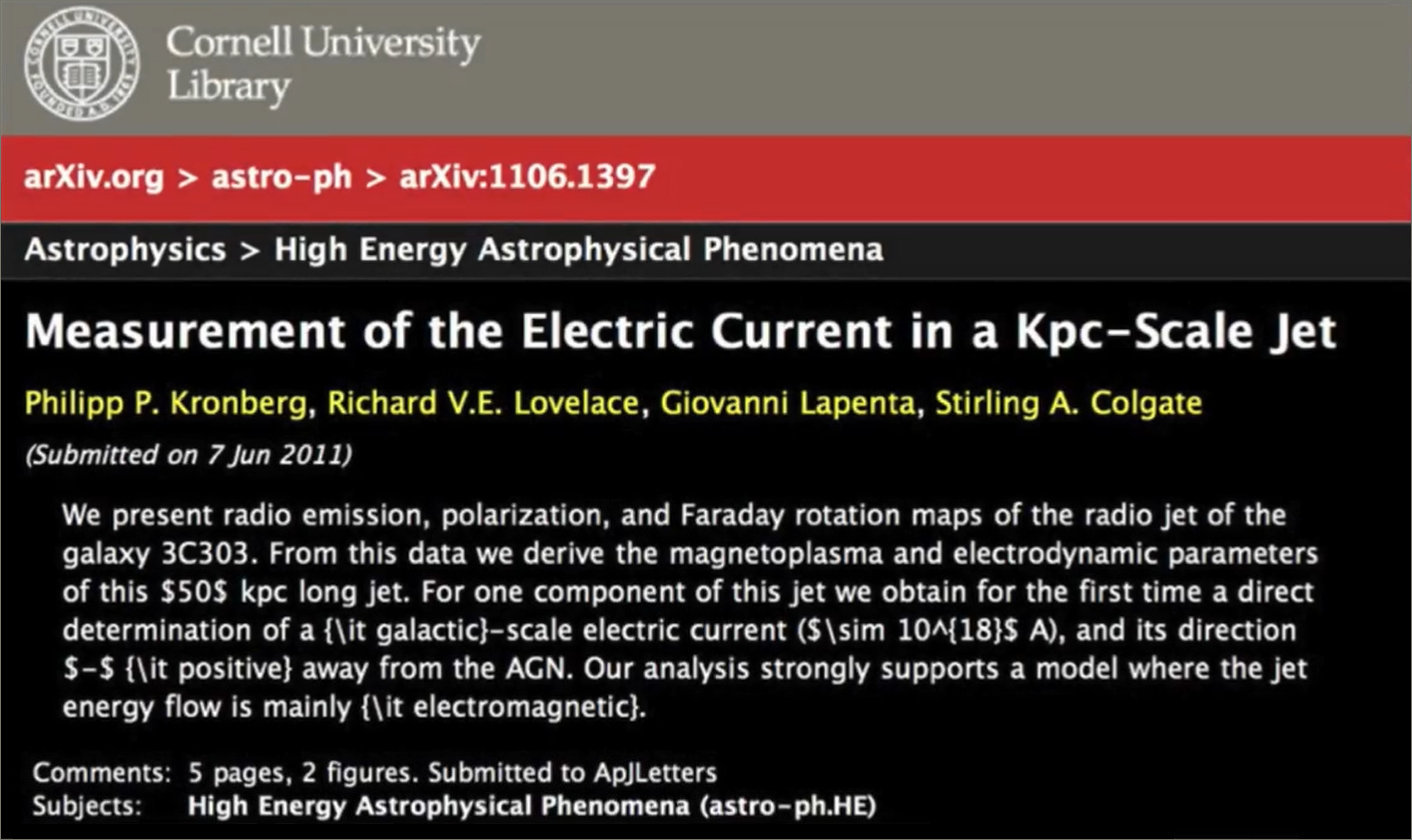
This is not merely a laboratory analogy. In 2011, Kronberg and colleagues reported the first direct determination of a galactic-scale electric
current, measuring a current of approximately 1018 amperes flowing along the kiloparsec-scale jet of the galaxy 3C303. Their analysis
concluded that the jet's energy flow was predominantly electromagnetic.
Could these similarities be telling us something important?
Plasma cosmology
suggests that such structures may not be incidental, but signatures of electromagnetic processes operating on a
cosmic scale. If so, gravity alone may not provide the whole story of how these remarkable objects form and remain
stable over such immense distances. As Hannes Alfvén repeatedly warned, elegant mathematics is no
guarantee that nature will behave accordingly:
“The underlying assumptions of cosmologists
today are developed with the most sophisticated mathematical methods and it is only the plasma itself which does
not ‘understand’ how beautiful the theories are and absolutely refuses to obey them.”
|
|
 |
| |
|
|
| Plate Tectonics, Earthquakes, and More |
|
|
| |
|
|
|
Most geological models describe the Earth as a predominantly thermal system, driven by convection, heat flow, and the slow circulation of material within the mantle.
But does heat alone adequately explain the full range of geological processes observed today?
EU Geology page
This thought-provoking paper examines the limitations of a purely heat-driven model and explores an alternative perspective: a solid–plastic Earth
that may be electrically stressed, possibly expanding, and influenced by
electromagnetic processes in ways that have received relatively little attention. Although technical, it is unusually accessible and addresses
some of the biggest questions in Earth science, including plate motion, crustal deformation, and the energy released during earthquakes.
Read the
paper.
Journal home:
scientificexploration.org
|
|
|
| |
|
|
| |
| |
|
| |

